Monday, June 17, 2013

Poetry Is Not For WIMPS

As a poet and an educator I am driven by a desire to have poetry viewed as consumer friendly by young people. I want them to enjoy the sheer magic of words the way I do. I want to share my love of language in the hope that they will come to know poetry as one does a friend.

What concerns me is that in too many classrooms the teaching of poetry has been reduced to a clinical examination. The poem as autopsy. The dis-aggregation of wondrous words by teachers who feel little empathy with the poet’s desire just to be shared.

Moira Robinson, my former neighbour,  in her book Making My Toenails Twinkle, reminds us that sometimes we miss the point of poetry when she states,

If we are going to start defining poetry by the number of times spring daffodils are mentioned, or by measuring its degree of seriousness on some poetic Richter scale, we will finish up with nervous breakdowns.’

If we truly want our students to appreciate poetry to the point that they themselves can gain satisfaction from their own written efforts we need to follow some basic steps in introducing poetry in the classroom.

We should firstly understand that poetry does not deserve to be pigeonholed into a neatly packaged work unit that conveniently coincides with National poetry day. Poetry should be a year long classroom staple, a friend to be valued through out the year and a cause for celebration. Poetry can be used to begin the day, end the day or introduced at a time during when it just feels right to share words of wonder. Poetry should above all move us to feel a range of emotions and should inspire our own writing efforts.

To feel completely at ease with teaching students to write poetry, requires a knowledge that goes beyond understanding what poetry is; it requires a teacher to understand how it is done; created. This knowledge is essential to fully appreciating poetry for its uniqueness as a form of expression. As Jacqueline Woodson writes, ‘Poetry is about joy and urgency in tiny spaces.’

We must avoid asking students to write poetry before they have been fully immersed in a close study of poetry- its range and complexity. -Its potential and possibilities. We need to dunk them in poetry soup!  Young writers need this time to get to know poetry and how to react to it. It is critical that they understand how it is different to prose.  The one criteria we must set when choosing poems to share with students is to choose poems that have initial appeal. If we as adults don’t enjoy a particular poem, don’t read it to impressionable students. Our distaste, our reservation will be obvious to our reading audience. Never waste valuable classroom time reading poetry, you don’t feel a connection too.  We should always practice reading a poem aloud several times before sharing it with an audience of young poetry consumers. Get the feel of the poem –its words and it rhythm. Know it well, so you read it as it feels.  Children hear poetry from an early age. They eagerly recite it. The next logical step is to get them reading it and from their discoveries and observations, begin to create their own.

Poetry needs to go beyond stylized Haiku and acrostic poetry using student names. Many teachers limit the possibilities to this narrow framework. Their own trepidation about poetry is on display here. Each year this is the meagre diet students are dished up. Imagine how ‘Li’ feels being asked to write an acrostic poem using her name. She would be envious of her classmate ‘Anastasia’, no doubt.  Opportunities abound to expose student writers to much more than this pale poetic portion.

Teaching poetry is not for wimps. It requires the input of brave writers of all ages.
And yet, poetry has for so long been poorly taught in too many classrooms. Words like – abused, ignored, misinterpreted, misunderstood, underutilized come to mind when one considers the history of poetry in schools. At the same time there have been teachers and students who have been enriched by the power and beauty of poetry. In such classes poetry has been presented with energy and verve.- Poetry taught in this way is both wild and wonderful. It possesses the potential to engage the imagination and provide real opportunities for students to more fully engage in authentic learning.

Poetry should be an essential ingredient in our classrooms –not some washed out, half hearted afterthought. There exists in poetry a rich language source that can be made readily accessible to the hearts and minds of students and their teachers. Through poetry teachers have an opportunity to encourage a genuine sense of mindfulness about what is being read, written and shared.

Running alongside this aspirational goal is the fact that when poetry is presented in a gradual and scaffolded manner students discover that poetry is easily accessed. If we set up the best possible conditions for poetry to emerge then it’s more likely to happen. So, as the guardians of poetry we must guide students to a place where poems live and words and ideas abound They might just  discover that writing poetry is enjoyable, rewarding and brings with it the opportunity to learn much about themselves. Jane Yolen refers to teachers as the code masters of poetry. Especially when they write poems for children. Poetry is not for wimps…

Go to http://alanjwrightpoetrypizzazz.blogspot.com.au/ for some practical ways to promote poetry with your student writers.


Tuesday, June 11, 2013

Reading, Writing and Real Life Connections.

Life and Literature enacted a strong connection for me recently as I vacationed on Bali at Candi Dasa. I stood on the beach at Pantai Pituh and just off shore was a small island. An island that bore a strong resemblance to the island depicted in Margaret Wild's beautiful picutre story book, 'Tanglewood.'
Such a special moment.  I immediately captured the scene with my camera. The eye of the writer and the mind of the reader working in harmony. 
What a magical connection. Check it out and see if you agree. 


Small island offshore from Pantai Pituh, near Candi Dasa, Bali, Indonesia


Slice of Life Tuesday-The Challenge Facing The People of Gili Trawangan

I have just spent a few days on a small island off Lombok called, Gili Trawangan. It was great to have a few days to unwind after some hectic work in recent months. As the fog in my head receded, the words began to flow and spill across my notebook pages. I embraced this experience. It was like a curtain being drawn back and revealing something exciting to the eye, the ear,  and the heart of the writer within. The pace of this small coral atoll requires the visitor to adapt to a slower pace. I had no cause to resist.

There are no cars allowed on Gili Trawangan. No motorbikes, No Trucks. In fact, the road that encompasses the entire island is little more than a dusty track (8 kilometres in total) in most parts and requires attentive navigation.  Bicycles are a favoured form of transport here. Many of the available tourist residences on the island offer- FREE BICYCLES as an incentive.  

Vicki and I clambered onto bicycles and joined the throng of riders. It’s hot dry work here. The heat of the day is intense.  You soon encounter loose, shifting sand that proves impenetrable on a bicycle. We are forced to dismount and walk. It’s a bit galling actually. We pass numerous other ‘walkers,’ and begin to understand where the term ‘push bikes’ may have originated. Great exercise though. Great sight seeing, -and pollution free transport at the same time.

Our island bike ride becomes a pattern of short riding stints interspersed by sand traps. We regularly dismount for fear of losing balance and toppling awkwardly into grey, gritty sand. Along the way we encounter a man selling fresh coconut drinks. He is conveniently situated at one of the many sand traps. Good business decision on his part, I thought.

The mass transit system on Gili is provided by pony carts that taxi people to all parts of the island. These ponies deserve the highest praise. These amazing little animals keep this island moving. They multi task in astonishing ways. Whether moving people and their luggage, or bricks and mortar, furniture, food and related goods, -it is the ponies that do the heavy haulage here. They are up for the challenge, resolutely pulling their varied loads throughout the day and into the night.

Adorned in harness and bridle bedecked with decorative bells attached to their chest-plates, they jauntily jingle along the dusty island tracks. You often hear them approaching a little before they trot fully into view –jingle, tinkle, tinkle, here comes the pony man.

In the last few years though, the tourists have been coming to this quaint little place in ever increasing numbers. They are attracted to the isolation, the quietness, not to mention the clear azure ocean and the chance to snorkel the surrounding coral reefs- and here’s the rub! With the tourists, development and the relentless push for progress accelerates rapidly. Simplicity is under threat, without doubt. I wonder how much longer the ponies can hold out against the odds here?


These thoughts and observations first appeared in my notebook while relaxing on Gili Trawangan. They have emerged here.
The Pony carts of Gili Trawangan Island


Push bike action on the dusty tracks of Gili Trawangan Island


Friday, May 24, 2013

Taking Your Writing To Another Place


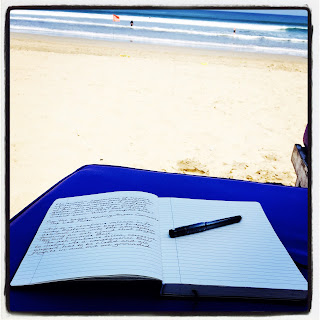
I am constantly reminding students and teachers how important it is to write in different locations. So, I am doing as I say and writing this piece from the small island of Gili Trawangan , situated off the coast of Lombok and a three hour boat ride from Bali.

Our lives tend to be about being busy. We move constantly from one seemingly important matter to the next. -Rushing and bustling to meet appointments and people. It’s little wonder our minds become cluttered and clouded with thoughts that serve to add confusion and indecision. The brain is full to overflowing. A fog descends. Thinking clearly becomes more of a challenge as we tire of the load.
My short time on this island has provided distance from those matters that refuse to be denied. It has given me time to sit still. It has allowed me the headspace to clear my thoughts. I sit facing the sea and I can gaze, ponder, wonder, observe, listen, smell, feel, think and appreciate, the simple pleasures of the moments surrounding the day. I embrace these precious thoughts. They are most welcome. My mind clears and my notebook pages fill easily with words.  Moments are magnified. They press upon my mind revealing possibilities.  Thoughts flow as easily as the tide that laps the shore in front of me. There exists in these moments, a clarity I appreciate as a writer. Is this a luxury? Yes, it is. But it is also a reminder of maintaining balance in our lives. Too much of any one thing is not a wise investment.

Many years ago I read Carmel Bird’s book, ‘Dear Writer’ in which she noted that writers need to consciously quarantine time to write. They must become a little self-indulgent in order to produce words. So, I am shamelessly claiming these few precious days to write in a different place, with a clear head. As painter, Paul Klee said, you adapt yourself to the contents of the paintbox. This location, far from home is my paintbox for these few days. I shall adapt quite willingly. I will walk, beachcomb, swim, read and ride a bike too, to feed the writer within. I must live in the world, otherwise I risk missing it…


This little island is engaged in a battle. -A battle of development. -A battle of inevitable change.  On one hand the inhabitants are resisting the march of mechanization by not allowing cars and motorbikes to be part of island life. Ponies and carts provide essential transport services here. This adds a sense of quiet and tranquillity to life here, not to mention lower pollution levels. The ponies add to the island’s appeal. Opposing this, tourism is flourishing and the island’s centre is expanding at a rapid rate; spreading like tentacles. With development comes a host of related issues. I want the ponies to survive this onslaught.


Tuesday, May 7, 2013

Slice of Life Story -On Ya Bike!

No one learns to ride a bicycle by observing pictures of one. No, we must clamber onto said two wheeled contraption and push off on our perilous first journey. It may be short lived and may involve a sudden ending. Our first efforts are most likely accompanied by a high degree of uncertainty and are characterized by white knuckled gripping of the handlebars. We wobble and shake in our desperate attempts to control the direction of the seemingly unmanageable machine. Our efforts are concentrated towards making those willful wheels travel in a straight line, avoiding potential hazards such as fences, potholes, power poles, - people!
 
Learning to ride a bicycle may also involve a few mishaps. It is most unusual not to experience the occasional ‘prang.’ -The kind of accident that separates rider and bicycle and occasions cuts, scrapes and a few bruises. A bit of bark of our knees comes with the territory the rider is exploring.
 
Despite such setbacks, the inexperienced rider generally persists and a measure of control begins to develop. The bicycle yields to the will of a determined rider. Eventually the ability to swerve around an errant dog, a muddy puddle, another cyclist emerges and the journey becomes more controlled, more predictable, less angst ridden (pardon the pun).
 
I frequently find myself reminding young writers of these facts and drawing an analogy with learning to write. Wobbly at first, the writer starts out with great uncertainty and a lack of control. Through practice, persistence and good old fashioned stickability, the writer develops greater self belief and control over the direction the writing takes.
 
This is a message we not only share with developing writers, it’s a message for adults as well. In recent weeks I have met a significant number of teachers who want to know more about being more effective teachers of writing. They are questioning their current practice. However, the vast majority of them do not write by choice. Their students do not see them as writers. There is an obvious disconnect between what they wish to achieve and what they are currently doing as teachers of writing.  This is a sad reality in too many classrooms.
 
The message to each of them is simple. -Just as you did all those years ago, - climb back onto the bike and start pedaling. -On your bike squire. There you go…
 
Brave writers (and bike riders) can be any age. It just requires the necessity of daring. The writer must stare down the shiny blank page and cover it slowly with words. In this way the writer asserts freedom and the power to act.   Words lead to more words and so the journey is underway. A bit like riding a bike actually…
Bicycle in Via Pelligrini , Rome October 2012


Friday, April 19, 2013

Living Life Twice @ the Thinking & Learning Conference May 17, Caulfield Racecourse


Looking forward to presenting at the 10th Annual Thinking & Learning Conference conducted by Hawker Brownlow Education. Would love to see you  at Caulfield Racecourse on May 17th to discuss 'The Write Stuff.' For more information contact- www.hbe.com.au


Tuesday, April 9, 2013

Slice of Life Tuesday -Striving For Authenticity


The challenge for those of us who are teachers of writing is how do we maintain our authenticity? How do we ensure that the words we speak in the name of writing are enacted in our deeds? How do our actions and beliefs about writing influence our student writers?

I am a reader and a writer. The things I do as both reader and writer are at the core of my teaching. I believe I cannot ask students to embark on learning tasks I have not experienced myself. If I want  students to adopt writing as a meaningful part of their learning, I need to demonstrate the intrinsic value of being someone who chooses to read and write.  I can show them how writing can be a way of solving problems. I need to be the embodiment of a positive model for these literacy siblings. Such actions provide confidence for students. They know that where they are going as writers is a path I, as a teacher, have already been down and continue to travel. I am blazing a trail and inviting them to join me.

If I ask student writers to step through the processes of writing without having experienced this myself, then my teaching lacks authenticity. The only way to develop this critical credibility is to demonstrate aspects of the writing craft openly with the young writers I teach. I become an authentic risk taker and my students begin to adopt an altogether different view of me and the messages I am trying to deliver. This very act takes a degree of courage. I am admitting a degree of vulnerability. I am also demonstrating to students a fair degree of trust. Writing can be tough work. It can be a challenge. Equally it can be a delight. Sometimes the words flow freely and sometimes you have to almost push them out and onto the page.  This understanding needs to be shared with young writers. When revealed, an awareness of writing’s great challenge is shared. It is about the realities of writing. If I do these things my practice remains authentic.

It will come as little surprise to teachers to be told how closely students observe their every action. For this reason children need to hang around a teacher who demonstrates clearly that reading and writing are essential to living a literate life. It is further proof of ‘showing, not just telling.’ I try to reinforce these messages every time I enter a classroom. If I consistently act this out, eventually –shift happens!

Student writers will respect these actions and revelations. They need to be surrounded by adults who are living examples of readers and writers. -Readers and writers willing to demonstrate their thinking, planning, drawing, writing, revising, editing, and publishing processes in mindful ways.  Our literate lives provide a cue for our students. This is where authenticity dwells. To quote the late, great Donald Graves, ‘When teachers have authentic voices, their students have them too.’  


Tuesday, April 2, 2013

Slice of Life Tuesday Greedy Pig Poems (Soundcloud)

During the just completed Slice of Life March Story Challenge I was alerted to the potential of Sound cloud for sharing information. I have fellow slicer,  Kevin Hodgson to thank for bringing this App to my attention. Kevin uses Soundcloud regularly, and effectively, so I am following his lead and venturing into a new realm...

Today, I am repackaging a couple of poems I wrote some years ago as part of  the 'Greedy Pig, Greedy Pig' collection of food inspired verse for young readers.


Soggy Beans In My Jeans

http://soundcloud.com/alwrite/soggy-beans-poem-at-mornington


Pasta Joke

http://soundcloud.com/alwrite/pasta-joke-poem


Poem by Alan j Wright, illustrations by Terry Denton


SOGGY BEANS

 Auntie Bess I must confess

I didn’t eat my greens

When you got up to make dessert

I hid them in my jeans

 
I then walked home to my place

As quiet as a mouse

My pockets full of soggy beans

Until I reached my house

 
Well, that was many years ago

And I was just a kid

And still, I don’t like soggy beans

-I Never Ever Did!

 
Alan j Wright

Sunday, March 31, 2013

Slice of Life Story Challenge March 31 -A Complete Month of Writing Slices

Today’s post represents the successful completion of my fifth March SLICE of Life Story Challenge. Each year it is like returning to visit with old friends. A reunion of like minds creates a sense of shared celebration.

As always, I make discoveries, for part of this journey involves exploring self. I am able to learn of common incidents by reading the words of fellow writers. These experiences allow me to contemplate and connect, despite the geographical differences. An enhanced appreciation is gained from the close examination of special moments in our lives.

I make discoveries, -words, phrases, ideas; the optimism that resides in the attitudes of my fellow writers. Involvement in this writing project enables me to give and receive feedback with respect to the words generated by fellow participants. As writers and life long learners this psychological stroking is vital. It feeds our willingness to persist. Taking part in this project requires a large amount of self discipline to write and post a slice of life entry each and every day. We embrace the challenge presented. It drives us on…

This year meeting the expectations of the Slice conspired to challenge me greatly at times.  The time differential is always there. However, frustration with unco-operative technology -freezing cursors, security barriers, weird, misaligned postings, blogger glitches and the like all conspired to block my way. On occasions, it took several hours work to successfully post a particular slice. Such persistent irritations served to remind me how strongly the need to complete the challenge burned within me.  
Conversely, a real positive that emerges from my participation each year is the sense of community one obtains when feedback is given and received. It is the responses that make it so worthwhile. To hear of common experiences, to hear of wonder and curiosity, to hear of empathy, excitement and joy are the elements that sustain us all. I love the sense of honesty, emotion and implied trust.  I have immense admiration for those who create time to comment so regularly. They display great stickability, dodging the barriers the internet throws up on regular intervals. I salute you all!

Like a moth to a flame, I am drawn to the task of composing my daily slice of life. The discipline required is rewarded each day. Congratulations and sincere thanks again go to Ruth and Stacy, for initiating this challenging, yet compelling quest. I am indebted to their vision.

As participants, we are far flung, yet united in purpose. We continue to support each others efforts as writers. This unity of purpose adds to the light shining around our words.  To those who have added their voices to the challenge this year –congratulations on your achievements.  Another March of rich memories is now captured in words –Wonderful to look back over. Words still warm to the touch…


The Urge To Write

You can listen to this extract from my book, 'Igniting Writing-When A Teacher Writes, Hawker Brownlow Education 2011
It focuses on 'The Urge to Write'
http://soundcloud.com/alwrite/the-urge-to-write


Saturday, March 30, 2013

Slice of Life Story Challenge- March 30 - Risky Business, Writing


This quiet Saturday finds me temporarily alone in the house in a reflective mood and a chance to scan through my poet's notebook. I happened to stumble across some raw words which I have reworked for today's post...

Risky Business

I sit at my desk some mornings
Confronted by slips of paper
Scribbled lists
And a head full of loosely connected thoughts
Fragments of a dream perhaps
I link them tenuously in my morning mind
Sorting them
Before writing…

I must remain courageous
I must a risk taker be
And write to the edges of thought and idea
Remembering always
The best writing
Requires such daring

Memories like ghosts float by
Lingering for just enough time
To explode in my head
I recall
I record
And words spill across the pages of my humble notebook

I am living life twice
Scribing questionable versions of reclaimed truths
My voice
My choice
I must remain courageous


Friday, March 29, 2013

Slice of Life Story Challenge March 29 -A Fiction Fragment

It is said that fiction is merely reality with a twist, so today I present a deliberate piece of fiction. A piece that finds its origins in events witnessed during my regular summer walks. It is a fragment of fiction. Recently in my notebook I have trying to weave some word magic, turning fact into fiction under the heading, ‘Fiction Fragment.’

‘Luther Longhurst loved his front veranda. He felt free and in charge each time he parked himself there. As verandas go, it was a small space, pokey even, with room for a single fold away director’s chair and a planter pot holding some straggly, unloved geraniums.

 Each morning when the summer air was at its freshest and the moist scents of the garden rose form the earth, Luther would step out his front door and onto his humble little veranda. He unquestionably owned the space.

The foldaway chair vanished under Luther’s large frame. He owned it. Taking his seat the big man immediately highlighted the relative fragility of the chair.

Luther’s time in this zone followed well established patterns. His next move involved lighting up a cigarette. Following ignition, he would throw his head back, cough at the sky and exhale a plume of smoke towards the heavens. He would then open the newspaper conveniently tucked under his arm and commence reading. Starting with the front page, always the front page, Luther worked his way through the tabloid news only stopping when the back page was completed.

The act of reading and smoking were entwined in Luther’s mind. One couldn’t occur without the other it seemed. Sitting here, he enacted his morning ritual. A ritual involving, smoke, fire and words.

Luther Longhurst loved his front verandah.’


Thursday, March 28, 2013

Slice of Life Story Challenge March 28 -In Pursuit of Peas


Out of necessity I journeyed into the supermarket today.  A single item was required. -A single item central to a recipe I had identified for our evening meal. If I could have avoided going in, I would have danced with delight. But alas, I was forced to accept the painful reality that spending time wandering the aisles was unavoidable. And so I blundered in…

The sight that greeted me was dispiriting. People in profusion. Checkout lines disappearing down the aisles. -Shopping baskets and trolleys absorbing space. An oncoming wave wandering shoppers of epic proportions began to swirl around me.

I dived in. Ducking and waving between shuffling shoppers I plunged deeper into this consumer hellhole. The frozen food section at the very rear of the supermarket was my target. I found the object of my desire, - a single packet of frozen peas and immediately began the return journey. Checkout bound, with quarry in hand, I felt as if I was part of a horror movie where everyone and everything around me was moving in ultra slow motion.  Every where I turned I was confronted by trolley blockades, indecisive confused consumers and shelf stacking staff.  So many dead ends, so much rerouting required.  I found myself fighting hard to suppress a growing sense of aisle anger. The checkout seemed a shore too far.  Finally, I spot the finish line. However, the queue to the self checkout stretches further than an elastic snake.

My heart sinks yet again. I’m fifteenth in line. I’m stranded. -And I’m holding a bag of frozen peas. What have I done to deserve this?  Well, I don’t know actually. But, I do know why I have a strong aversion to supermarkets.

I eventually emerge with my pack of peas and I look back at the mayhem. Why do people panic buy before holidays? Why do they feel the need to stock up with trolley loads of consumerables?  Is it because the supermarkets will be closed tomorrow, Good Friday?

With peas in hand, I walk away and I don’t look back.

Wednesday, March 27, 2013

Slice of Life Story Challenge March 27 - Clinging To The News

In the early gloom of morning, I gather the newspaper lying at the far end of the driveway, in front of our house. I spend the next couple of minutes extricating it from the highly resistant plastic wrap protecting it from the elements. For someone who is keen to get in touch with the news of the moment, this problem solving activity creates some level of frustration. I grimace. I rip and tear. Finally, the plastic yields to my will. The news is mine…

Once the paper is freed from its cling wrap cocoon, it is down to some serious reading. The smell of the newsprint and the sheer pleasure I gain from reading the world is all I need to get my brain swirling.

Recently my newspaper of choice made a deliberate decision to shrink from a broadsheet to a tabloid configuration. It saves the publisher money and it makes the paper much easier to manage the fold and read for newsprint addicts. The change of size is an adjustment.  My news is now condensed and has a new look and feel.

Newspapers do not hold the eminent news position they once held, but because I have always read them, I remain loyal. Mind you, I also get my news from web based news platforms as well as social media formats such as Twitter and Facebook. I also receive news feeds on my phone, so I pretty much have a news feed through -out the day covered.


I am grateful to newspapers though, because they have played a significant part in my becoming a reader. As a child, I scoured the newspaper each day for sporting results and articles. In those far off days, I would begin reading from the back of the newspaper because that is where you found all the sports related information. Sport was my passion. These days, I begin at the front and gradually work my way to the sporting section. My need for a sporting fix has lessened. My needs and interests as a reader have broadened considerably. However, newspapers remain part of my morning routine and wandering around in the newsprint remains an enduring pleasure.

Tuesday, March 26, 2013

Slice of Life Story Challenge March 26 - Feeding Readers And Watching Them Grow


Today I had the privilege of awarding books to a group of Grade 5 readers who have worked consistently to further develop their personal reading performance across this first term of the school year. These students have embraced a series of challenges starting on the first day of school this year as part of a concerted effort to improve reading outcomes.
  • Reading for longer periods to improve reading stamina
  • Reading in different settings –school, home, outdoors
  • Reading across a range of genres –going out of your comfort zone
  • Reading to learn and learning to read
  • Engaging in quality conversations about books at school and at home.
There has been constant modeling of what it means to live a literate life. Conversations in every classroom have centred on all things to do with books.

 Supporting these broad aims their teachers and I used assessment data to inform the teaching program around reading comprehension. In particular, the data indicated that the teaching needed to focus on the readers’ abilities to generate questions, form inferences, question the author, interpret a character’s actions, summarize, identify literary devices (idiom, metaphor, simile) vocabulary and repair meaning.   

The level of reader engagement has been pleasingly high. Students have willingly embraced the challenges. It is reflected in the improving quality of their responses. The improvement in reading stamina is palpable.  The emergence of reading communities is a joy to behold.

So, it was with great pleasure that I had the opportunity to hand out copies of Steven Herrick’s verse novel, ‘Pookie Aleera is Not My Boyfriend’ to readers identified by their teachers as having made a concerted effort to improve their personal reading. I informed the students that this book was among the best books I read in 2012. The looks on the faces of students upon receiving a copy of this book was gratifying to see. -Genuine surprise all round.
 
The teachers have instituted a holiday reading program and students have reading reflection journals to record aspects of their reading across the Easter term break. The reading season goes on…