Posts

Showing posts with the label Pre Writing

Alerting Young Writers to the Value of Rehearsal- Alan j Wright

Image
  Writing has a dimension that extends well beyond the page and the pen.      While the words spill across the page, the ideas driving them frequently arise well away from where the writing eventually takes place.      As author, Jane Yolen notes in her book, Take Joy, ‘Writing is not always done on the page.’      Experienced writers devote a significant amount of time to the preparation for writing. They may at various times, read, research, discuss, draw, plan, think, brainstorm, either individually, or in concert.       From these pre-writing activities they may simultaneously launch into rehearsal of words and ideas in locations well away from their favoured writing location.      Rehearsal is an impressively portable concept. It can be conducted anywhere, anytime- in the car, in the shower, in a café, at the beach, the airport, or just before you drift off to sleep. It can be activated whi...
Teaching Metacognitively with Young Writers

Image
The ability of young writers to reflect upon their written works and to reflect upon the thinking that influenced their writing processes is of significant importance.  It is essential to develop a sense of ones-self when writing.  It is a critical component when striving for improved levels of writing attainment. Young writers begin to thrive when metacognitive awareness and reflection is fostered by their teachers.  The role teachers play in this growth of metacognition is evidenced when writers in a classroom community exhibit a shared metalanguage while discussing aspects of their individual writing process. When prompted in this way young writers willingly convey their writing intentions, or engage purposefully in writing conversations (writing conferences) with fellow writers -peers and teachers alike. In other words, they discuss the events surrounding their writing lives, and they do it using the specific vocabulary of writing. This is the result of teacher's...

The Writer, As Observer of the World

Image
Each morning, whenever possible, I walk in the fresh air, not too long after the sun has peeped above the far horizon. Being on holiday at present enables me to walk more frequently. I use the time to organize my thoughts, drink in a little of my surroundings, and collect possibilities. I take my phone for music. It is also there to enable me to collect photographic evidence. Surprises await the keen observer. Since the age of about ten I have been enamored by photography. As a teacher and a writer, this love of the photographic image has been a most positive influence of my work, my life. It has aided my eye as a writer. It has piqued my curiosity. It has opened me up to possibility and enlivened my senses.  Small detail has become increasingly important. What takes place inside a camera can also take place inside your head. My eyes are alert to the magic that flashes before me. As teachers of writing we need to be collectors. We must observe, collect and ...

Adequately Preparing Student Writers to Write PERSUASIVELY

Image
I have previously stated my belief that teaching students to write   persuasively , (to influence a reader) is about far more than writing to a formula, or recipe!   What is the First Step? I believe we need to introduce young writers to the language of  p ersuasion. The language of   introduction I believe, I feel, I think,   The language of   connectives however, therefore, because, although, yet, in addition to. The language of   conclusion In summary, I recommend, In conclusion In the classroom we begin by fostering quality conversations… A sea of talk should pervade classroom discussion and conversation around pertinent issues. Talking to learn should be a guiding principle in planning lessons. Successful discussion requires students to reflect on what they are doing as learners.    If students don’t know the process of discussion they remain dependent on the teacher to tell them what ...

SOL 2015 March 26 - Telling Tales & Harvesting Ideas

Image
Students frequently ask, where do you get your ideas for writing? Well, today when the same question came up, I read them this poem... Telling Tales I like to tell myself stories I invent them in my head They rock and roll around my mind They entertain me on the bus They are with me as I walk down Union Street They are there when I enter the subway They ride with me through the underground tunnels My stories roll around in my head until they are ready to be told Then… They emerge like warm clothes from a tumble dryer Fresh, new and ready to be written across the pages of my notebook Everything’s write in the end

Harvesting Words Then Letting Them Emerge

Image
I have been away from this space for some time. I have not been idle though. I have continued writing. It has just been in other places. My notebook writing has been vigorously pursued and I have been working on a new book. I have also been working, travelling and reading. Annie Dillard’s words in ‘The Writing Life’  resonate frequently. ‘ The writer is careful what he reads, for that is what he will write. He is careful of what he learns, because that is what he will know. ’ I keep these words close at all times.  A writer needs to absorb ideas and indulge in adventures in order to provide output. It is in living that the writer harvests the essential treasure to be transformed into words.  I had to immerse myself in the experience before the words could emerge. My recent adventures are swirling around in my head. They are ready to be transformed into words… I recently returned from almost four weeks in Italy . During my visit I saw a host of noteworthy things. ...

Slice of Life Tuesday -Striving For Authenticity

Image
The challenge for those of us who are teachers of writing is how do we maintain our authenticity? How do we ensure that the words we speak in the name of writing are enacted in our deeds? How do our actions and beliefs about writing influence our student writers? I am a reader and a writer. The things I do as both reader and writer are at the core of my teaching. I believe I cannot ask students to embark on learning tasks I have not experienced myself. If I want  students to adopt writing as a meaningful part of their learning, I need to demonstrate the intrinsic value of being someone who chooses to read and write.  I can show them how writing can be a way of solving problems. I need to be the embodiment of a positive model for these literacy siblings. Such actions provide confidence for students. They know that where they are going as writers is a path I, as a teacher, have already been down and continue to travel. I am blazing a trail and inviting them to join me. ...

Pre Writing -Removing The Cold Starts

Image
UPDATED October 2025 I find it increasingly re-assuring to witness teaching practice that recognizes the importance of the pre-writing phase of the process. I am witnessing fewer cold starts where the topic is presented to a class of students and they are immediately instructed to begin writing. This cold start writing was a common practice during my primary school days. Sadly, it has not been totally extinguished from the pedagogical practices in some schools. I remain hopeful of its eventual extinction. Assisting students to' get ready to write' lays the foundation for producing an improved writing product and sets the writer up to be more successful. Pre-writing involves that critical time when thoughts are transformed into meaning and begin to be integrated into the writer’s action plan. It is the gestation period for writing ideas. James Britten says, ‘It is during pre-writing that the past experiences of the writer serve to colour facts according to the writer’s point...

Empowering Our Youngest Writers

Image
In recent days, I have spent a considerable amount of time in classrooms along side our youngest writers. I have worked with teachers of these emerging writers and in every instance these educators are striving to provide opportunities for their students to develop a healthy perception of themselves as writers. Daily opportunities to write on topics and ideas selected by the students themselves have been a feature. Encouragement for students to experiment with sounds and letters as they develop increasing confidence to composing meaningful messages for others to read. These young authors are developing important understandings about what it means to write. They are also being consistently supported to learn useful strategies to guide them in the processes of writing. Gradually they are forming a sense of form and genre and craft through their writing experiences. They are also experimenting with writing conventions. I witnessed powerful evidentce of students' reading the room' ...

Views From Writing Classrooms - Effective Use of Anchor Charts and Displays

Image
I was reminded recently that when teachers complain that they have no power it is simply not true. They control the very weather in their classrooms. Upon entering a classroom it takes little time to assess what the teacher values. The evidence is all around the room. It is revealed in the atmosphere that exists in the room, the interaction between the students themselves, and between the teacher and the students. It is also revealed in the physical environment. The presence of anchor charts reveals the tracks of the learning taking place. The way they are used to support student learning reveals the value teachers place on such resources. When students are free to access resources within the room, it reveals the levels of trust that exist. I have been gathering evidence from a host of classes lately. The data reveals how teachers are responding to the needs of their developing writers. Supporting them and directing their attention to important ideas about aspects of writing. In th...

The Way Forward With Brainstorming

Image
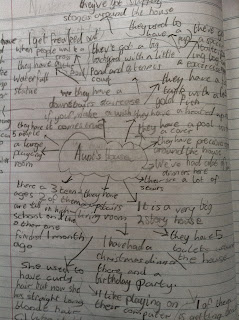
 Student's comprehensive brainstorming sample This post is appearing  similtaneously on The Two Writing Teachers blog site where I am honoured to be this week's guest blogger. I hope you enjoy reading about brainstorming. I also hope you find strategies here that you can readily apply to your own writing workshops.                 Brainstorming is a strategy that has many learning applications. In this post, as guest blogger, I want to specifically look at brainstorming within the context of writing workshop and how we can assist developing writers to use it more effectively. It would be inaccurate to think of pre-writing as merely brainstorming. From my observations many teachers do, unfortunately. This is not to say that brainstorming is not a critical pre writing skill for young writers to acquire. In fact, it provides an excellent way to deepen student thinking around a new to...