Posts

Showing posts with the label conversations

Talk And The Developing Writer
Image
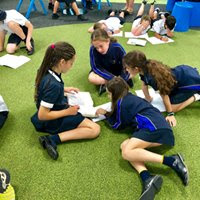
            Talk And The Developing Writer. Talk is an integral part of learning, and no less so within the writing workshop. The legendary writing researcher, writer and educator, Donald Graves, regularly encouraged young writers to think aloud and articulate their writing intentions. He wanted young writers to give voice to the intended direction of their, soon to emerge, writing. It is said, the more we articulate our intentions, the more likely we are to actually pursue them. So, providing opportunities for inexperienced writers to engage in this kind of targeted talk needs to be embraced within the working structures of the writing workshop. Graves further prompted young writers to explain their individual writing processes - the journey and its associated actions that brought about the writing piece. Increasingly, the importance of sharing process is being recognized as a critical component within the writing workshop. Young writers need min...

Some Writing Conversations To Launch the School Year

Image
  In the early weeks of a new school year, we would hopefully expect to hear conversations around writing raising matters with student writers, similar in intent to the types of matters listed below. Conversations that prompt thought and produce action. Are you writing about things that matter to you -matters you care most about, matters close to your heart? If your students are writing merely to please a teacher or impress their peers, then this conversation is quite important. We should never embark upon writing we don’t care about. It should matter to the writer. It might actually be a piece they need to write quite urgently because they never want to forget that particular moment/ feeling/ event/ experience. Is there something you are hoping to see improve around your writing this year? How do you intend to achieve this change? Do you know why you are writing about a particular topic/issue/idea? In other words, have you thought about why it is important for you to write about t...

Share Time -Essential To Writing Workshop

Image
It goes by several names. That brief few minutes at the end of the writing workshop. Sometimes it’s called ‘share time’. Some people refer to it as ‘share out’ or simply “share.” It’s that time at the conclusion of a lesson that all too often gets squeezed out, which is a tragedy, because it represents a critical stage in the lesson, -It’s the finale that’s provides closure to an effective lesson. It’s when the fat lady of writing sings. And the aria is in praise of the writing that has just taken place! Deny her time in the spotlight and you are diminishing the integrity of your writing program. We should never underestimate the intrinsic value of ‘sharing’ writing. It remains an incredibly valuable teaching and learning opportunity. It should be protected within the workshop structure, as one would protect anything of value. For the teacher, it provides an invaluable opportunity to provide feedback on elements of the lesson just concluded. Sometimes it’s a chance to c...

Reviewing Student-Teacher Writing Conferences

Image
Too often kids think a ‘writing conference’ is where the teacher ‘fixes’ your writing...  The notion of a conference as a ' conversation between two writers ' needs to be at the heart of a conference.  If we want provide our writing lessons with authenticity then as teachers we must encourage students writers to request a conference when needed rather than foisting one upon them. There's little to be gained interrupting the flow of a writer deep in the act of composing a piece, just to conduct a writing conference. On the other hand, there's little point in making a writer wait when they desperately need your support to deal with a perceived roadblock in their writing.  It therefore makes sense to set up a system where the needs of the writer are placed at the centre of the action. Better to implement a conferring system where the writer is encouraged to identify a need to confer and is able to initiate some discourse around their writing.  The stude...

Answering Questions Posed by Young POETS

Image
UPDATED, May 2020 As a frequent visitor to schools I have the great pleasure of working with groups of young, enthusiastic poets and their teachers. When I arrive in a classroom, young poets are often pre-loaded with questions, and most keen to have them answered.  I try to answer as many as I can, but we frequently run out of time, and the poetry caravan moves on to the next classroom. So I am here to answer some of those questions -right here, right now. So here goes: When you were little did you love writing? The short answer is yes. I have always enjoyed words and language. I can't recall a time when I wasn't doing some kind of writing. When did you write your first poetry book? I have had poems published over the years, but it wasn't until 2014 that I had an entire book of poems (an anthology) published. When I looked back through all my notebooks I realized I had hundreds of poems from which to choose. So, 'Searching For Hen's Teeth-Poetry From The ...

Helping Students Add DETAIL To Their Writing

Image
I recall how my teachers often glided by as we were engaged in writing and following a cursory glance at our assembled words frequently uttered the phrase, - ‘ You need more detail’   while waving a finger above the page. They would then move on again seemingly before we had a chance ask a follow up question. We were left to ponder the deeper meaning of ‘details’ and what exactly this meant for our writing. They didn’t hang around long enough to go into detail about details… For me this has always been a sticking point. Telling a young writer to add more detail without explaining what this actually means for the writing is about as useful as a paper vase. So, the question arises, - What do we mean by detail? Well, we need to unpack the idea of detail so the writer can see exactly what is meant. Too often this translates to throwing a host of adjectives into the mix to make the writing more ‘descriptive.’   Teachers sometimes tell stud...

Encouraging Deeper Writing Conversations With Students

Image
   When students begin talking about their writing, they usually want to tell you what it is about, not how it is written. Sharing subject matter is important, but we want to encourage students to talk about their writing in more sophisticated ways. Over time student writers can be encouraged to talk about their purpose as writers, their audience for each piece of writing, and the techniques they use as writers in order to reach their audience. We also need to teach children to have similar conversations with each other about their respective writing pieces. In order to encourage this sort of “writing workshop conversation,” you can set up specific paired sharing times for students to share their writing in the way you have modeled in conferences.   You can pose specific questions or tasks for the sharing sessions, such as: ‘I want you to talk with your partner about why you are writing your story—what feelings do you want the reader to feel?’ or ‘Try to find as ...