Posts

Showing posts with the label Think Aloud

The Underpinnings of Effective Pedagogy in the Writing Classroom

Image
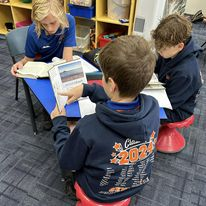
  When young learners confidently employ meta language while discussing their writing, it indicates the underpinning of mindful teaching . Talk is crucial to the writer and such use of accurate writing terms does not come about by accident or osmosis . It arises when teachers consciously articulate such terms while undertaking their considered work as teachers of writing. They think aloud, they share their own writing process , model and demonstrate the behaviours and attitudes they wish to see among the developing writers in their care. They teach metacognitively . They are consistent in their approach to teaching, and they reinforce effective writing actions witnessed in the classroom and beyond. It is most evident they are securing their teaching practices on sound foundations. These actions are quite obviously, deliberate. They articulate the meta language they want young writers to adopt and confidently use. They are living the very behaviours they wish...
Teaching Metacognitively with Young Writers

Image
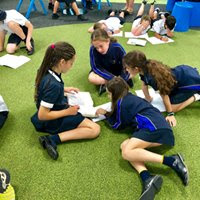
The ability of young writers to reflect upon their written works and to reflect upon the thinking that influenced their writing processes is of significant importance.  It is essential to develop a sense of ones-self when writing.  It is a critical component when striving for improved levels of writing attainment. Young writers begin to thrive when metacognitive awareness and reflection is fostered by their teachers.  The role teachers play in this growth of metacognition is evidenced when writers in a classroom community exhibit a shared metalanguage while discussing aspects of their individual writing process. When prompted in this way young writers willingly convey their writing intentions, or engage purposefully in writing conversations (writing conferences) with fellow writers -peers and teachers alike. In other words, they discuss the events surrounding their writing lives, and they do it using the specific vocabulary of writing. This is the result of teacher's...

Talk And The Developing Writer

Image
            Talk And The Developing Writer. Talk is an integral part of learning, and no less so within the writing workshop. The legendary writing researcher, writer and educator, Donald Graves, regularly encouraged young writers to think aloud and articulate their writing intentions. He wanted young writers to give voice to the intended direction of their, soon to emerge, writing. It is said, the more we articulate our intentions, the more likely we are to actually pursue them. So, providing opportunities for inexperienced writers to engage in this kind of targeted talk needs to be embraced within the working structures of the writing workshop. Graves further prompted young writers to explain their individual writing processes - the journey and its associated actions that brought about the writing piece. Increasingly, the importance of sharing process is being recognized as a critical component within the writing workshop. Young writers need min...

Critical Considerations For Writing Teachers

Image
The childhood of my youth appears to have gone the way of tape recorders, cassette players, CD's and the like. At the very least such items are on an endangered list. When sharing childhood experiences with today’s generation of students, I realize that our respective childhood experiences are world's apart. My generation grew up in small houses with big backyards. The focus of our daily existence was the world outdoors. We had extraordinary freedom to explore our immediate world. The children I now work with, (and I’m talking in general terms here) live in bigger houses, with small backyards and the focus of their lives is frequently indoors. The growth of digital technology in its myriad forms calls after them like a siren. It urges them to remain under cover. X box, computer games, and a multitude of screens win out over an outdoor lifestyle. The digital revolution has swept over our lives like a metaphorical tsunami. Freedom appears to have diminished. It ...

Teachers and Writing Topics

Image
A teacher laments how students struggle to think of topics for their writing. ‘They never seem to come up with much, they can't think for themselves, so that’s why I have to give them sentence starters.’ The words jar in my ears.  I have had this kind of exchange numerous times over the years... Teachers coming from this paradigm frequently ask. ‘Could you demonstrate how writers get their ideas?’ I find myself wondering if the teacher has ever considered this same question? I get the distinct feeling I am expected to fix these young writers in some way.  I feel strongly that the answers lie elsewhere. Had any inquiry taken place? Had those young writers been asked to explore this same idea? Had they been asked- what makes a good idea for writing? Where do writers find ideas? How do they prevent ideas from drifting away? Demonstrating and modelling how we connect to the world around us is a vital lesson for our students. We need to demonstrat...

Fostering Thinking Among Student Writers

Image
  My earliest memories of writing are entwined around the weekly writing topics I was given in primary school. We wrote every Thursday afternoon, immediately after the lunch break. It wasn't even called writing. Our teacher referred to it as 'composition time.' We wrote for about twenty minutes in absolute silence in our 'composition' books.  At the end of the allotted time, we handed in our written responses, then waited an entire week to receive feedback for our labored efforts. It consisted of a mark out of ten and a page of red ink comments and slashes across the page. Then we sat and waited for the next teacher topic to be thrown our way. We wrote one day a week for twenty minutes. It wasn't much of a writing program by today's standards. It wasn't much of a way to learn writing back then either. I'm surprised we learned to write at all on such a starvation diet. I was just lucky enough to be the kind of kid who was driven to write in pl...

Promoting Curiosity and Wonder Among Student Writers

Image
I have been promoting the use of magnifying glasses in classrooms for some time. I want the curious learners in our classrooms to have the opportunity to discover and celebrate natural wonder. I recall how much fun I had as a small boy with my own magnifying glass. –Seeing snails and slugs up close, or watching ants and noticing their fine feelers, or exploring nature’s wonders in the fine lines and patterns on leaves. There was for me, a fascination observing the world through this magic portal; this round window.  I want the natural curiosity children possess further stimulated by the experience of seeing small wonders up close and personal. I hope a magnifying glass stimulates their imagination and creativity. I hope they respond with wonderment and awe. A magnifying glass is not a piece of cutting edge techno wizardry, but it is a powerful tool for determining answers to questions that spring from every day experiences. Seymour Simon said ‘ I’m more interested in ...

Have Students Read Their Writing Aloud When Revising

Image
If we purposefully teach student writers the habit of  ‘rereading’ their writing, we provide them with a powerful tool for improving the quality of their writing. This reading includes, rereading as they draft,   and rereading as part of revision. They begin to hear their words as a reader will hear them. It provides powerful feedback.   When drafting a piece of writing the developing writer is commonly driven by the production of words across the page. The urgency surrounds the act of writing,  so the writer is not necessarily focusing on what the words are ultimately saying. The result is often- too many words or too many ideas. The writing may lack focus.  A decision is required at this point. What exactly do I want my words to say and mean?   It may be difficult to throw away words considered precious. Remember though, each word cut from the text may lead to preserving the energy of the overall piece. The writ...