Posts

Showing posts with the label Feedback

Preserving Integrity Around The Writer's Notebook In The Classroom
Image
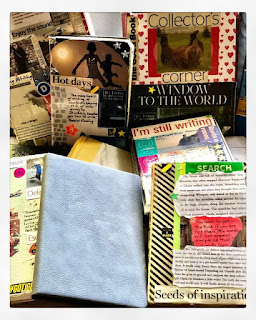
  Writer Joan Didion famously said our (writer’s) notebooks give us away. We are revealed by the contents. Our notebooks are a place to collect, then take those collected items and use them to spark further original writing. As Ralph Fletcher, writer and educator reminds us, we use our notebooks to breathe in (collect) and breathe out (generate). With these thoughts ringing in my ears, I envisage notebooks brimming with words and ideas across a range of subjects and genres. The notebook is a place to experiment, take risks, make important discoveries, or excavate memories and ideas from deep within. It can be a place to have fun with words. So why is it that in some classrooms when students take out their notebooks the pages reveal a picture far removed from the images I have just outlined?     Why does one get the impression that the notebook in these school settings is only realizing a small part of its potential? Why is the critical ingredient –‘writing,’ so lacki...
Regular Practice Is Essential For Growing Student Writers

Image
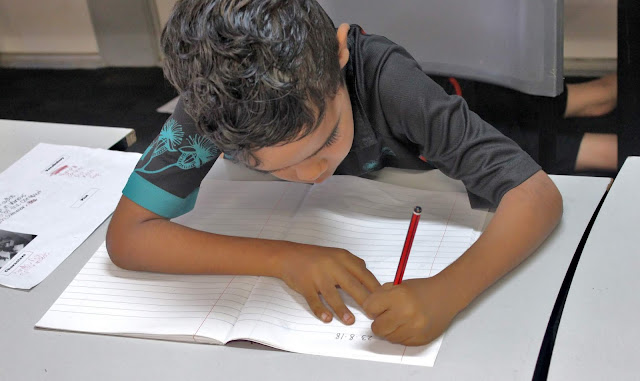
It is most important for students to understand there is a real purpose to the writing we all do. To understand that through writing they can gain a greater understanding of themselves and the world in which they live is paramount. Through writing they can communicate with a specific audience across time and space.It is through writing they can find a voice for their thoughts and ideas. It is important for them to know their writing efforts are valued. Young writers therefore need adequate time and space to develop. Available research data shows when children are provided with opportunities to write every day they begin to compose even when they are not actually writing. In other words they begin to think about their writing beyond the confines of the classroom. This is where rehearsal for writing begins to impact the thinking of the emerging writer. As a teacher, I have always gained immense satisfaction from hearing students, who upon entering the classroom first thing ...

Share Time -Critical To the Development of Student Writers

Image
It goes by several names. That brief few minutes at the end of the writing workshop. Sometimes it’s called ‘share time’. Some people refer to  it as ‘share out’ or simply 'share.' It’s that time at the conclusion of a lesson that all too often gets squeezed out, This is a tragedy given it represents a critical stage in the lesson. The integrity of the writing program is diminished if these important writing matters are not reviewed. We should never underestimate the intrinsic value of ‘sharing’ writing. It remains an incredibly valuable teaching and learning opportunity. It should be protected within the workshop structure, as one would protect anything of value. For the teacher, it provides an invaluable opportunity to provide feedback on elements of the lesson just concluded. It is also an opportunity to link that day's workshop to future action the writer might consider. Sometimes, it’s a chance to celebrate a discovery, a breakthrough, a special moment where th...

Narrowing The Gap Between Student Writing Intentions And Actions.

Image
UPDATED: August 2022 How do we assist young writers to narrow the gap between their writing intentions and their actions? This remains an ongoing challenge for all of us who teach writing. Too often, the inexperienced writer signals their intention to commence a writing project yet somewhere along the writing pathway they either get distracted, overwhelmed, or just plain lost. It is claimed, the more we articulate our plans for action, the more likely we are to translate intention into action. This suggests we should be encouraging the developing writer to talk about their writing ideas. They should initially internalize their thoughts regarding writing intentions - think and rehearse before being asked to share with fellow writers. To foster this kind of conversation around writing, it would be prudent to set up opportunities for students to discuss their burgeoning ideas with partners, small groups, trusted peers, teachers.  The young writer could be furthe...

The Nurturing of Self Directed, Independent Writers

Image
The Nurturing of Self Directed , Independent Writers As a classroom teacher, parent information evenings always meant the inevitable question arose, ‘What are your expectations for my son/daughter this year?’ It’s a great question to ask a teacher and I was prepared for it, having thought long and hard about how I would respond.  I always wanted my students to develop into independent, self-directed learners and I had a year to achieve my goal. With the support of parents and the co-operation of the students, it was a goal for all of us to pursue.  When attempting to foster self-directed learners, everything we do becomes important -what we do as educators; in every aspect of our teaching  Let’s consider what we do in the writing classroom. In an increasing number of classrooms teachers encourage student writers to choose their own topics and writing projects. They purposefully teach their students routines and procedures for conducting themselves independ...

Overcoming Obstacles to REVISION

Image
Reading writing aloud before sharing. A frequent lament a mong teachers of writing is the resistance encountered among some students when it comes to revision. However, such resistance tends to evaporate when certain elements become essential to the writing workshop. Topic Choice/Genre Choice When young writers are writing what they really want to write about, the words tend to flow more easily and as a consequence, the writer displays a greater commitment to the challenge of ‘getting it right.’ From this position, the writer often approaches revision with increased endeavour. Choice is central to success in writing. It increases ownership and assists the writer to develop a sense of voice. If a student feels a greater sense of self in the writing, they take greater care with the words and the message. They are therefore more likely to embrace revision. Authentic Purpose There needs to be a real purpose for the writing that is undertaken. If writing is viewed as...

SOL2015 March 11 Turning Up The Volume In Student Writing

Image
A priority for any writing program is to progressively build the stamina of young writers, enabling them to sustain their writing efforts for extended periods. The aim is for the writer to reach a stage where the ideas flow freely and the blank page surrenders to a relentless flow of words. Well, today I found myself striving towards that end with three classes of Grade 4 writers. Too often young writers become distracted and a gap emerges between their intent and their action. The talking so vital in the pre-writing phase continues into the composing stage and the promise of words evaporates. I promised these young and enthusiastic writers that we would have plenty of time for more talk and discussion when we had produced some words on the page. Issues frequently arise that interrupt the flow of writing. Some young writers get hung up on perfectionism. They censor and edit in their heads. Consequently, the words have trouble making it onto the page. They allow...