Posts

Showing posts with the label publishing

Creating Opportunities For Kids To Publish /Share Their Writing Is Important

Image
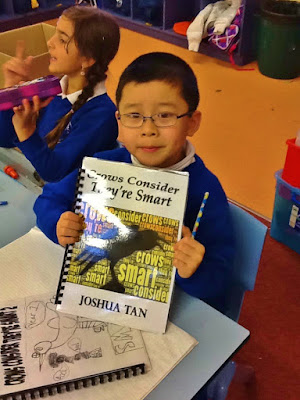
  A recent question from a teacher prompted me to think more deeply about publishing student writing . She was searching for professional reading that dealt more deeply with the publishing phase of the writing process. My own search revealed that many of the available texts deal more comprehensively with the lead up (revision, editing) to publishing than publishing itself. It doesn’t seem to get the attention that it deserves. Publishing and all it entails is only lightly explored in many professional texts.  I have always believed that when the young writer reaches this important stage of the process, a wonderful opportunity exists for empowering the writer to make some really important decisions concerning the shape and form of the final product.  I had to go back to one of my earliest books on writing- ‘ Writing, Teachers and Children at Work ’, Donald Graves , to find any meaty detail surrounding this part of the process. Reading Graves’ words was like...
Assisting Young Writers To Create Effective Titles

Image
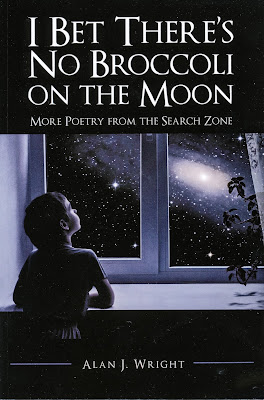
  Inexperienced writers don't usually afford titles of their written work much attention, investing little time thinking about or choosing a title. They are often viewed by young writers as labels or unimaginative cliches, rather than titles.   For this reason I would suggest a study of book titles across a range of genres is well worth the investment in time. As a writer, I have come to appreciate the important role titles play in any written piece. The title is a critical part of marketing appeal and for that reason publishers and writers take a lot of care with the choice of their titles.    I once spent almost two months pondering the title for a poetry anthology I had written.  All the poems were in place, but a suitable title was proving somewhat elusive. I rejected many potential titles before eventually choosing one I believed was a bit quirky and had some appeal to a reader's curiosity. I considered this a worthwhile investment in time. Some might ...

Launching Writing Projects From The Notebook

Image
  One of the challenges facing writing teachers is how best to support student writers to move the writing focus beyond their writer’s notebook towards more intensive and sustained writing projects. We want the young writer to lift their gaze beyond the edges of the notebook and strike out in new areas with their writing.  The writer’s notebook is a tool for writing. It is not intended for the entries to become ensnared; trapped in a word prison. The notebook contains many beginnings and not all of them are destined to be launched beyond the notebook pages, but their presence affords the writer options.  The skill lies in identifying and lifting out that piece, or pieces, the writer feels have the most potential for developing into something beyond the notebook page. It will be a piece they can imagine themselves working on for a longer time. Engaging writers in conversations that encourages a desire to delve back into notebook entries, engage in some considered re-readin...

The Journey from Notebook Entries to Writing Projects

Image
The question arises- How do we best facilitate lifting the writing out and up in order for it to be shared with a broader audience? How can we as teachers of writing support inexperienced young writers to successfully move from collecting writer’s notebook entries to identifying their own writing projects .  Helping the inexperienced writer avoid becoming trapped in a whirlpool of copious notebook entries (that never grow and develop into something more fully developed) remains a critical consideration, for those of us responsible for teaching writing. The writer’s notebook is a tool for writing. It is not intended for the entries to become ensnared; trapped in a word prison. The notebook contains many beginnings and not all of them are destined to be launched beyond the notebook pages, but their presence affords the writer options. The skill lies in identifying and lifting out that piece, or pieces, the writer feels have the most potential for developing into something bey...

The Architecture of The Writing Workshop

Image
I continue to field questions concerning the structure, or architecture of the writer’s workshop. Graduate teachers, teachers from other jurisdictions, teachers returning from leave all seeking to know and understand the basics of structure around the workshop. So, let’s revisit this critical consideration: Component Purpose What Happens? Connection/tuning in/ To help students make connections to previous work and to activate their prior knowledge.   Talk about how this topic fits with the class’ previous learning and how it connects with the student’s as both readers and writers   (Remember yesterday when we were discussing...?’) Teaching/ Mini Lesson To clearly or explicitly show students how to do something we’d like them to practice as writers. To explicitly and mindfully communicate the focus of the lesson Demonstrate, explain to students a strategy to try. Retelling or rolepl...

Adopting A New Approach To Publishing In The Classroom

Image
I must state from the beginning that I have long  held misgivings regarding what passes as publishing (of student writing) in many schools. Like fast food, publishing student writing has evolved into something pretty much standardized.  A one size fits all mentality often applies to the publishing phase of the writing process. Publishing should not be every student publishing their writing at the same time, in exactly the same way. Yes, publishing is time consuming, but it presents a powerful mechanism for motivating students to continue reading and writing. Publishing should allow students a strong sense of ownership over a host of decisions regarding the shape and form of the final product of their writing efforts. I think that for some teachers 'publishing' becomes a beast that needs to be controlled. This need to control is what ultimately stifles creativity, resulting in a pie factory outcome. We should hold fast to the idea that publishing means ‘to make the writing...