Posts

Showing posts with the label Agency

Assisting Young Writers to Create Meaningful Memoirs

Image
  Young writers are inexperienced at writing memoir, but there are some significant actions teachers can take to significantly support and enhance the writing they produce… Memoir is detection, the sifting through a million lived moments in order to identify the most memorable ones.  The memoir writer rebuilds a part of their life, piece by piece to share with a reader.  The spark for the memoir might come from the colour of a favourite pencil, the secrets held safely by an old teddy. A first pet.  It might involve adventures in your neighbourhood, the sounds, shapes and smells of your first house, that special tree, your first disappointment, an incident, an accident. A place that holds a story. Just as home is the place we know best, our families are at the centre of the stories we often hold dear. Some of the experiences the writer is having right now may remain with them forever as memories. The challenge for the writer is to capture them in their writing…  ...

Developing Agency and Volition Among Young Writers

Image
  Some of my earliest memories of writing are entwined around the weekly writing topics I was given in primary school. We wrote every Thursday afternoon, immediately after the lunch break. It wasn't even called writing. Our teacher referred to it as 'composition time.' We wrote for about twenty minutes in absolute silence in our 'composition' books.  At the end of the allotted time, we handed in our written responses, then waited an entire week to receive feedback for our labored efforts. It consisted of a mark out of ten and a page of red ink comments and slashes across the page. Then we sat and waited for the next teacher topic to be thrown our way. We wrote one day a week for twenty minutes. It wasn't much of a writing program by today's standards. It wasn't much of a way to learn writing back then either. I'm surprised we learned to write at all on such a starvation diet. I was just lucky enough to be the kind of kid who was driven to write in pl...

Notebook Revelations That Empower Student Writers

Image
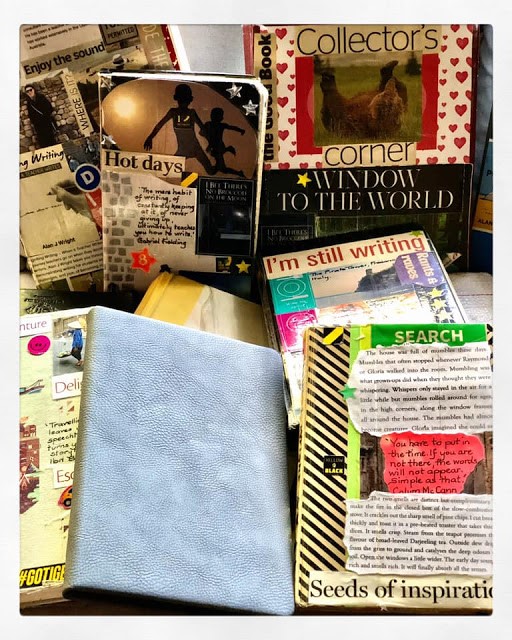
  Writer Joan Didion said our (writer’s) notebooks give us away. We are revealed by the contents. Our notebooks are a place to initially collect and then take those collected items and use them to spark further writing. As Ralph Fletcher , writer and educator reminds us, we use our notebooks to breathe in (collect) and breathe out (generate). With such thoughts ringing in my ears, I envisage notebooks brimming with words and ideas across a range of subjects and genres. The notebook is a place to experiment, take risks, make important discoveries or excavate memories and ideas from deep within. It can be a place to play with words. Writing becomes a pleasure. So why is it that in many classrooms when students take out their notebooks the pages reveal a picture far removed from the images I have just outlined?   Why does one get the impression that the notebook in these school settings is only realizing a small part of its potential? Why is the critical ingredi...

Creating Opportunities For Kids To Publish /Share Their Writing Is Important

Image
  A recent question from a teacher prompted me to think more deeply about publishing student writing . She was searching for professional reading that dealt more deeply with the publishing phase of the writing process. My own search revealed that many of the available texts deal more comprehensively with the lead up (revision, editing) to publishing than publishing itself. It doesn’t seem to get the attention that it deserves. Publishing and all it entails is only lightly explored in many professional texts.  I have always believed that when the young writer reaches this important stage of the process, a wonderful opportunity exists for empowering the writer to make some really important decisions concerning the shape and form of the final product.  I had to go back to one of my earliest books on writing- ‘ Writing, Teachers and Children at Work ’, Donald Graves , to find any meaty detail surrounding this part of the process. Reading Graves’ words was like...

The Role of Rehearsal In the Development of Young Writers

Image
Writing ideas swirl round in my head. I live with them for days, sometimes weeks, before they emerge on the page. I frequently wake up thinking about the possible shape of my writing for that day. I woke up thinking about my writing this morning. Later in the morning over a welcome cappuccino, I talked about my ideas –further sorting out took place. -Rehearsal for the writing to follow. I understand rehearsal is critical to my writing. I willingly embrace it. I know it assists me to clarify my ideas; find my direction.  Playing with words and ideas in the head is such a critical part of the writing process. Think of it like a tumble drier with thoughts and ideas rolling around and around until they are ready to be taken out. Warm and fresh. Mind you, there are times when all that emerges is a single sock of an idea –along with a bit of fluff attached. It looks and feels incomplete. It is writing in need of further consideration. But that’s okay; it may just require further shaping ...

Writer's Notebook- A Valuable Writing Resource

Image
When introduced to the classroom,  the Writer's Notebook has the potential to exert a significant influence on the written efforts of all writers within that learning environment:  Fostering Creativity  Idea Generation:  The notebook serves as a repository for ideas, observations, and inspirations, allowing writers to capture and develop their thoughts. Used in this way the writer retains ownership over ideas.  The notebook becomes a gathering place for precious and fragile ideas; -Ideas that might need time to growin the writer's mind until such times as they are ready to be expanded upon. Used this way the notebook becomes a treasure chest for potential ideas.  Experimentation: The notebook provides a safe space for writers to try out new techniques, styles, and voices, promoting experimentation and innovation. The unique character of each writer has an opportunity to flourish. A true sense of agency develops.   Developing Writing Habits  R...

Assisting Young Writers To Increase Writing Output

Image
  Let's Turn Up The Volume In Student Writing!   A priority for any writing program should be to progressively build the stamina of young writers, enabling them to sustain their writing efforts for extended periods. The aim is for the writer to reach a stage where the ideas flow freely and the blank page surrenders to a relentless flow of words. We want young writers to view the blank page as an invitation to write, rather than something filling them with trepidation.   The answer lies in the act of writing. Too often young writers become distracted and a gap emerges between their intent and their action. The talking so vital in the pre-writing phase continues into the composing stage and the promise of words not surprisingly, evaporates. There should be plenty of time for talk and discussion when the writer has produced some words on the page. We owe it to the writer to provide such discussion time.   A range of issues may arise to interrupt the flow of...

The Need To Feed Your Writer's Notebook

Image
When discussing writer's notebooks with inexperienced writers, I frequently refer to the idea of 'feeding' them. Smiles immediately appear on the faces of the young writers seated before me. I further explain the notion of feeding the notebook by using the analogy of a garden where the plants are well fed and tended. Plants flourish when their care is made a priority. A garden neglected soon withers and dies. A failure to thrive sets in.  I have seen this in gardens and with writer's notebooks. The enthusiasm that launched these ventures soon fades -and the nourishment required to sustain them falls away. Where notebooks are concerned, malnutrition is more likely to occur where teachers are not actively maintaining their own writer's notebooks.  What do we feed our notebooks? All those small and juicy thoughts, ideas and observations collected as we negotiate our various worlds. This is the rich detail we must gather in our notebooks. Detail that stimulates more gro...

The Limitations Of Allocating 'Free Writing Time'

Image
It is important to note that a personal writing project does not equate to the allocation of ‘free writing time.’ where the writer is given a small portion of time to write ‘creatively.’  Free writing time generally focuses upon the time given, rather than the actual writing that may be involved.  For this reason free writing time is little more than a tokenistic gesture. It lacks gravitas, for its purpose is often ill defined. It is offered in the misguided belief that such an allocation of time provides sufficient investment in supporting and engaging young writers. It fails to enshrine authentic writing practice, selling young writers short. It's an example of fickle literacy. When a writer chooses to write 'freely' in order to discover what it is they want to say, they may pursue the drafting of a piece to determine what is important, by trying out ideas. Here they are trying things out with a purpose in mind.   Doling out occasional periods of 'free writing time...