Posts

Showing posts with the label metacognitive

The Underpinnings of Effective Pedagogy in the Writing Classroom

Image
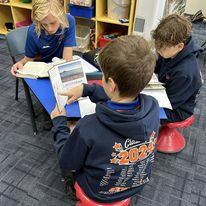
  When young learners confidently employ meta language while discussing their writing, it indicates the underpinning of mindful teaching . Talk is crucial to the writer and such use of accurate writing terms does not come about by accident or osmosis . It arises when teachers consciously articulate such terms while undertaking their considered work as teachers of writing. They think aloud, they share their own writing process , model and demonstrate the behaviours and attitudes they wish to see among the developing writers in their care. They teach metacognitively . They are consistent in their approach to teaching, and they reinforce effective writing actions witnessed in the classroom and beyond. It is most evident they are securing their teaching practices on sound foundations. These actions are quite obviously, deliberate. They articulate the meta language they want young writers to adopt and confidently use. They are living the very behaviours they wish...

Teaching Metacognitively with Young Writers

Image
The ability of young writers to reflect upon their written works and to reflect upon the thinking that influenced their writing processes is of significant importance.  It is essential to develop a sense of ones-self when writing.  It is a critical component when striving for improved levels of writing attainment. Young writers begin to thrive when metacognitive awareness and reflection is fostered by their teachers.  The role teachers play in this growth of metacognition is evidenced when writers in a classroom community exhibit a shared metalanguage while discussing aspects of their individual writing process. When prompted in this way young writers willingly convey their writing intentions, or engage purposefully in writing conversations (writing conferences) with fellow writers -peers and teachers alike. In other words, they discuss the events surrounding their writing lives, and they do it using the specific vocabulary of writing. This is the result of teacher's...

Encouraging Reflection Among Young Writers

Image
  Reflecting upon our writing lives, is a form of metacognition. We look back in order to discover. We may uncover truths. We may discover we are unconsciously skilled. We may also discover the need to redirect our energies, unpacking important details or revelations to guide our writing lives forward. Reflecting reveals signposts essential to writing development. As teachers of writing, it is vital that we encourage the growth of these same understandings with student writers. We must assist them to develop an  awareness of their own learning. Through mindful teaching, the inexperienced writer can be encouraged to to think and operate independently. In our day to day teaching we strive to assist the developing writer to be more aware of their thought processes. Attaining such a level of awareness will help them immeasurably as learners and in that process they become better writers. If we, as teachers encourage student writers to use reflection as a thinking tool, as well as ...

Purposeful Conversations To Assist Young Writers

Image
T he conversations teachers conduct with young learners have the capacity to greatly influence writing development.  The art of conversation and the posing of meaningful questions is a skill educators would do well to mindfully develop.  The potential of these interactions to influence attitudes writing and outcomes should never be underestimated. The way we talk to young learners influences the very climate within the classroom. Open  up your classroom to authentic dialogue. It will deliver a little sunshine...      Opportunities to initiate writing conversations arise daily, throughout every writing workshop. Like all skills we hone, our abilities to ask questions through mindful actions benefit from regular practice.       Such conversations may take place during roving conferences, during strategy groups, check in groups, during individual writing conferences/conversations and also during share time.  They can be facilitated bet...

Encouraging Young Writers To Notice Inspiring Words

Image
Here's a way to encourage the growth of metacognitive writers and support young writers to pay greater attention to the wondrous words of fellow writers. Ask your curious and keen young learners to gather some of their favourite books, then choose a page number. Turn to that page in each book and read until your eyes settle on words you wish you had written. Copy that extract with full attribution into your notebook.It is most important to acknowledge the source of the words chosen. This can be hand written or typed. I chose to type my chosen extracts, sometimes though I hand write them. When you finish compiling your entries, talk to a fellow writer and explain your choices. Envisage yourself writing in that style. Don't forget to try it first before you invite your young writers to try it for themselves. It's a wonderful opportunity to model how practice reading like a writer. This strategy differs from 'Words I Wish I Had Written' which involves writing random e...

Investing in Meaningful Student Writing Engagement

Image
The late, great Donald Graves reminded us in his 1983 book, Writing: Teachers & Children at Work' -  'Good teachers show what they mean instead of telling.' Katie Wood Ray in her 1999 book 'Wondrous Words' urged teachers to model writing work habits so students would come to see themselves as authentic writers. She further pointed out-  'Either we can be walking breathing, talking examples of all we advocate for our students, or we can have them sitting around wondering why are trying to get them into something that we are obviously not into ourselves.' These notions challenge the traditional and often dominant paradigm in many schools that writing is to prove to others what has been learned. In reality writing needs to be about discovery leading to reflection of learning. Writing is the  physical representation of all the thinking acquired. It arises from being deeply immersed in the processes of writing. When young writers are mindfully encouraged to t...

Promoting Student Ownership Of Writing Ideas

Image
  Promoting Student Ownership Of Writing Ideas  -Without Choice, You Won’t Get Voice   Upon discovering some young writers have endured a regular diet of teacher selected topics and genres, sentence starters, and story leads stretching across their short writing lives, it is hardly a surprise to hear they subsequently exhibit difficulty and anxiety when asked to self-select writing topics. It is little wonder they suffer a crisis of confidence when asked to rely on their own thinking and ideas.  They perceive the request as daunting because their independent thinking capabilities have been stifled and undernourished.  They have been denied important opportunities to develop motivation and initiative as writers. They remain inexperienced in the art of decision making and the critical thinking that surrounding choice and voice. Cognition will not take place where the young writer perceives the notion of topics resides solely with the teacher. They remain unawa...

The Critical Think Before the Ink-Rehearsal

Image
Writing ideas swirl round in my head. I live with them for days and sometimes weeks before they emerge on the page. I frequently wake up thinking about the possible shape of my writing for that day. Most days I wake thinking about my writing for that day. Later in the morning over a welcome cappuccino, I might talk about it, do some associated reading and begin scratching out preliminary ideas. I willingly embrace the swirling and mingling, happening in my head. Further sorting out takes place. -All this is part of the rehearsal for the writing to follow. I understand rehearsal is critical to my writing. I embrace it as an integral part of writing. It assists me in clarifying my ideas; to find my direction.  Playing with words and ideas in one's head is such an important part of the writing process. Think of it like a tumble drier with thoughts and ideas rolling around and around until they are ready to be taken out and spread across the page. They emerge warm and ready ...

Critical Considerations For Writing Teachers

Image
The childhood of my youth appears to have gone the way of tape recorders, cassette players, CD's and the like. At the very least such items are on an endangered list. When sharing childhood experiences with today’s generation of students, I realize that our respective childhood experiences are world's apart. My generation grew up in small houses with big backyards. The focus of our daily existence was the world outdoors. We had extraordinary freedom to explore our immediate world. The children I now work with, (and I’m talking in general terms here) live in bigger houses, with small backyards and the focus of their lives is frequently indoors. The growth of digital technology in its myriad forms calls after them like a siren. It urges them to remain under cover. X box, computer games, and a multitude of screens win out over an outdoor lifestyle. The digital revolution has swept over our lives like a metaphorical tsunami. Freedom appears to have diminished. It ...