Posts

Showing posts with the label Writing volume

Assisting Young Writers To Increase Writing Output

Image
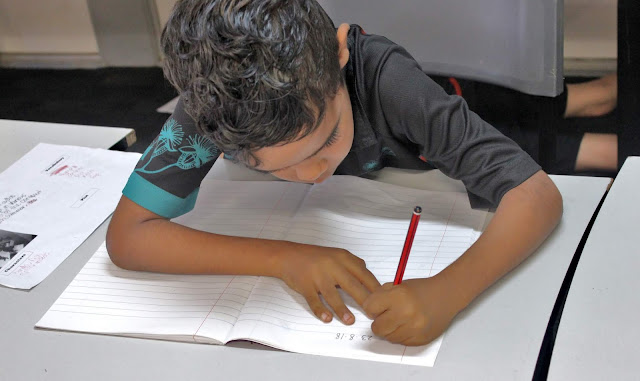
  Let's Turn Up The Volume In Student Writing!   A priority for any writing program should be to progressively build the stamina of young writers, enabling them to sustain their writing efforts for extended periods. The aim is for the writer to reach a stage where the ideas flow freely and the blank page surrenders to a relentless flow of words. We want young writers to view the blank page as an invitation to write, rather than something filling them with trepidation.   The answer lies in the act of writing. Too often young writers become distracted and a gap emerges between their intent and their action. The talking so vital in the pre-writing phase continues into the composing stage and the promise of words not surprisingly, evaporates. There should be plenty of time for talk and discussion when the writer has produced some words on the page. We owe it to the writer to provide such discussion time.   A range of issues may arise to interrupt the flow of...

Understanding Young Writers With Output Issues

Image
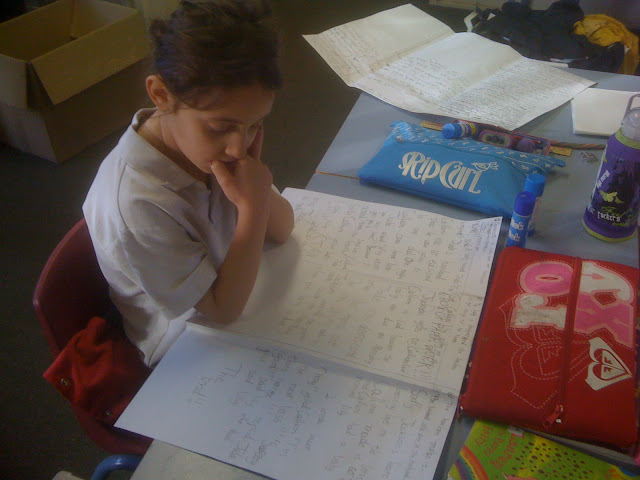
Sadly, a small, yet persistent group of kid blamers,  exist in our schools... They rationalize the events in their classrooms by informing everyone certain of their students are lazy, unmotivated, disengaged. While that may be the individual's perception, the critical question that begs answering is, ‘Why?’ If a student appears reluctant to write, to read, to participate in general classroom activities - that needs to be explored. It may be an issue external to the classroom, It may also be an issue related to the classroom or teaching style. Either way, to simply blame the student falls well short of professional responsibility. This issue of output failure is explored in 'The Myth of Laziness' by Mel Levine. Levine argues the desire to be productive is universal, but that drive can be frustrated by dysfunction that inhibits optimal output or productivity. Levine explains that difficulties associated with writing are far and away the most telling sign of output failure dur...

Regular Practice Is Essential For Growing Student Writers

Image
It is most important for students to understand there is a real purpose to the writing we all do. To understand that through writing they can gain a greater understanding of themselves and the world in which they live is paramount. Through writing they can communicate with a specific audience across time and space.It is through writing they can find a voice for their thoughts and ideas. It is important for them to know their writing efforts are valued. Young writers therefore need adequate time and space to develop. Available research data shows when children are provided with opportunities to write every day they begin to compose even when they are not actually writing. In other words they begin to think about their writing beyond the confines of the classroom. This is where rehearsal for writing begins to impact the thinking of the emerging writer. As a teacher, I have always gained immense satisfaction from hearing students, who upon entering the classroom first thing ...

What Do Teachers Mean By 'Independent Writing?'

Image
It always concerns me when student writers approach the task of writing, lacking any sense of freedom to explore and manipulate ideas. They commonly experience emotional blocks when it comes to making decisions. A distinct lack of confidence is evident. They ask questions of their teachers such as: How much should I write? Should I use paragraphs? What should I write about? Is it okay to write about...? The term 'independent writing' is an accepted phase within the writing workshop, but a closer examination reveals the writing taking place at this point is all too frequently, independent in name only. All too often young writers can be observed working on an assigned writing task and the questions they ask indicate they are a long way short of being independent and self directed. This scenario suggests  the whole notion of independent writing may require a significant rethink in such classrooms. -And yet, in other classrooms I gain a sense that the writers are ...

Further Jottings From A Writing Life

Image
These random writing thoughts are gleaned from various sources connected to my writing life- my writer's notebooks, blogs, Twitter, Facebook. They represent some of my recent writing related activity in these places. Not all these observation as memorable, but they are mine. I collected them. I share them to demonstrate the broad and enduring influences upon those of us who choose to be, teachers who write: _______________________________________ I would hate to live a life so full of time pressures that I couldn't possibly expend the time to return a shopping trolley after visiting the supermarket. You can choose to teach according to curriculum (or school based mandates), adopting a tick the box mentality, or you can teach according to what you know about the particular needs of learners. Without doubt, the difference is significant, the impact lingering! Blindly adhering to curriculum mandates does not make your pedagogy authentic. Let curric...

Reviewing The Role of My Writer's Notebook

Image
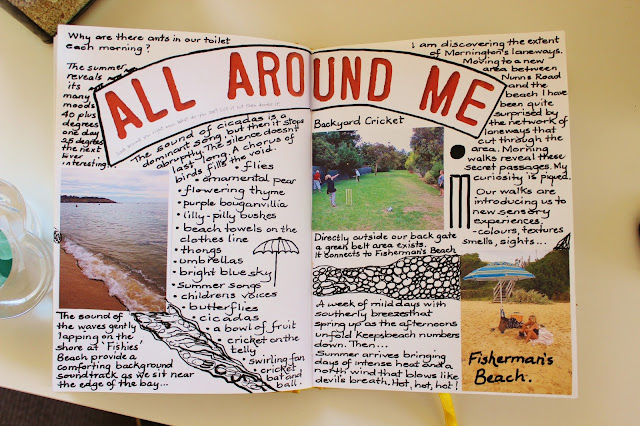
I feel a compelling need to revisit notions of what it means to use a writer’s notebook as a writing tool. Firstly, I understand, not every writer has a notebook in the traditional sense, but many do. I am one of the many. My relationship with writer’s notebooks winds all the way back to September, 1983. Across the intervening years, my notebooks have been various. I have an extensive collections of notebooks. Notebooks documenting my journey as a writer across more than three decades provide a rich paper trail from which I am able to mine some writing wisdom. Mu notebooks have evolved over time with respect to shape, form, and content. However, there are elements of that notebook/writer relationship which have remained consistently unchanged. Each notebook has been sturdy in its design. All my notebooks have had strong spines and hardy covers. Most have had ruled lines, but occasionally I have consciously chosen a new notebook with totally blank pages. I enjoy the variety such...

A Great Writing Habit: Rereading Your Writer's Notebook

Image
 I am forever rereading writing pieces from my notebooks. I greatly appreciate how much rereading older entries assists me in discovering a new idea to feed this writing life addiction. Virginia Woolf defines rereading as a chance to find diamonds in the dust-heap. I find myself frequently covered in dust and constantly looking for precious gems. I am acutely aware that rereading is vitally important to me as a writer. Apart from the possibility of finding a new writing thread, I am also reliving the moment in time when I first captured a particular entry. On some occasions rereading connects me with previously over looked memories or ideas. So apart from reading to revise or proofread, I would also add rereading for the express purpose of excavating ideas. This rereading is akin to rummaging through a toy box as a child and discovering a lost treasure. It works best when I leave some time between the writing and the rereading. Often i deliberately chose an older noteb...

Rereading Writer's Notebooks To Extract New Ideas

Image
I am forever rereading writing pieces from my notebooks. It is amazing how often such rereading assists me to dig up a new idea to feed my writing addiction. Virginia Woolf defines rereading as a chance to find diamonds in the dust-heap. I am definitely covered in dust and constantly looking for precious gems. My numerous notebooks are a critical part of my reading library. The role they play in my writing life changes upon completion, but the influence is sustained.  I am acutely aware that rereading is vitally important to me as a writer. Apart from the possibility of finding a new writing thread, I am also reliving the moment in time when I first captured a particular entry. What a buzz. On some occasions rereading connects me with previously overlooked memories or ideas. So, apart from reading to revise or proofread, rereading for the express purpose of excavating fresh ideas is important too. This rereading is akin to rummaging through a toy box as a child and discov...