Friday, April 13, 2012

Preparing Student Writers to Write PERSUASIVELY PART 3
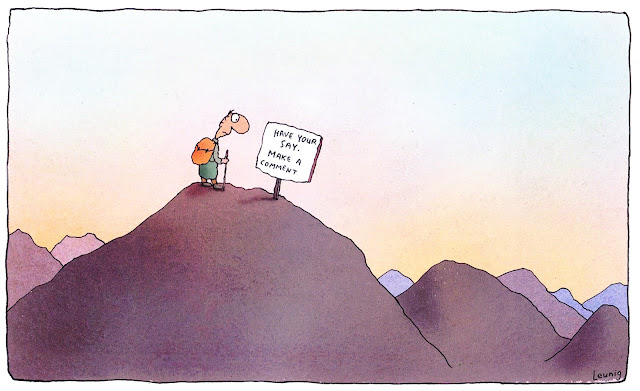
PART 3  When the writing begins: Encourage the development of a persuasive tone into ALL writing students undertake. All writers try to influence the reader. They have a purpose when they write and we must embed this understanding in the minds of young writers. The writer evokes a response, or a change in attitude from the reader and is thus fulfilled.

Show students how the writer is using words to influence and inform the reader.

What craft is the writer using to achieve this?

What do you notice about the writers voice?

What words are the most powerful?

What is the writers point of view here?

AVOID immediately descending into a pale imitation of a persuasive essay. The need here is to focus on the reasons for writing, rather than being mesmerized by the form.


HELPING STUDENT WRITERS EXPLORE ISSUES

What matters to you enough to want to write about it, or explore it in your writing?
What frustrates or annoys you?
What is something you feel strongly enough about to write it down
How do other authors present such issues and could you do something similar?

TALK ABOUT:
Issues and they way they affect people and communities
Ways to bring about a change, or improvement

REHEARSE:

How they would support a cause or deal with an issue in their writing.

Encourage students to talk about an issue with a partner as if they were talking to a reader.

DOCUMENT/ CHART:
Some of the words, phrases etc that the mentor authors are using to influence the reader.

LIST:
Issues that matter to your students
Possible audiences

When young writers initially write persuasively they do little research.
Opinions have little or no justification.
Vague generalizations are made.
Result?  -The reader remains to be convinced.
Is this our starting point?

If we want our students to be effective persuaders in their writing we need to engage them in many learning experiences that will strengthen their understanding of persuasive texts and what writers do to effectively persuade others.

 Source: Is That A Fact Teaching non fiction Writing K-3, Tony Stead

OUR PLANNING NEEDS TO FOCUS ON BUILDING:

Reading and Writing stamina

World knowledge

Text knowledge

Vocabulary

Oral Language


The ISSUE of Increasing Student Stamina for Reading and Writing


 How long do my students engage in independent reading and writing
each day?
How do I progressively increase time on task?

Vocabulary/World Knowledge/Text Knowledge
  
Read to, Share with children good quality non fiction
Use vocabulary interchangeably, and explicitly
View documentary DVDs on multiple topics
Provide good quality non fiction texts for independent reading
Deconstruct texts to examine their features and structure

In What Ways Do Writers Influence Us?


By warning us through their writing (fiction and non fiction)

By telling a story that brings the issue to our attention

By telling a story that has a message

By providing examples

By describing details

By begging us to change

By writing letters public and personal

By writing about something worth preserving or protecting

By describing a scene to highlight a problem

By writing poetry

By writing about how to treat people, places, objects, treasures

By inspiring us to try new things

By inspiring us to be brave or resolute

By describing the benefits to be gained by a particular action/actions

By repeating words, or a group of words (word patterns) to add emphasis

By writing a story with a moral

By employing humour to diffuse an issue

By asking questions


Writers prod us to think more deeply about an issue.


The Issue of Cohesion in Student Writing

(*I am grateful to Jeff Anderson for highlighting this issue in his book, Ten Things Every Writer Needs To Know)

Cohesion is the GLUE that holds the words together. It assists the writer to create smooth joins between sentences.
Cohesion assists the reader to navigate their way through a sea of words

Making Cohesion Work for Student Writers

Teach them about transitional words and phrases

Teach them to summarize with transitions

Teach them the old to new strategy

Teach them that pronouns need an antecedent

Teach them to repeat key words and phrases

Teach them to be consistent with tenses, point of view and mood

Teach them to cull irrelevant text

Teach them to use punctuation and grammar with deliberate intent.


Overcoming Connectivity Problems
Transitional words and phrases help connect ideas. They emphasize details, reveal organization, illuminate comparisons and contrasts
Auto Transitions are familiar to young writers. They overuse them!
Firstly, secondly, thirdly, fourthly fifthly and, in conclusion!

Transitions
Our students need to actively PROCESS, NOTICE and EXPERIENCE how other authors use transitions in REAL texts.
 Students need to understand the function of various transitions.This must happen BEFORE they are ever provided with a LIST!


Examples of relevant vocabulary for concluding a persuasive text
Ways to sum it up:

In conclusion .

Given the above points..

To summarise ……

There are many reasons

I recommend

Consequently it seems better to

The weight of evidence would suggest

This, in summary

It can seem that

I propose

On balance .

It would seem that

The facts are compelling for one to think that


Modelling- Teachers Need to Model For Students

How to organize information

How to include persuasive language

How to use connectives to link information

How to use text features (photographs, labels, charts) to help the reader

How to connect concluding statements to introduction
Use of facts and opinions to support stance taken.
Use of connectives therefore, as a result, because etc.
Use of hyperbole, emotive terms, repetition

Encourage Student Reflection:

Whats the point?-  Persuasive texts are designed to persuade people
or to convince  people of a point of view. Good persuasive texts
tantalise the reader. Does yours do this?
Have you got a plan?- These texts are usually well planned and thought out, Is yours?
Where to start?- Is your introduction boring, do you think the reader/listener will continue to be interested
Have you drawn the audience in by making a bold statement.
Have you addressed the main issue and stated your position.
Connect with the reader- Have you used connectives that explain your view like: however, therefore, because, although, yet, in addition to.

 Final Thoughts..

Traditionally teachers used tests as tools. We must be careful NOT to become tools of the test!


'Writing is the largest orchestra a childs mind has to conduct
Writing assists students to practice being organized and effective. Writing is a platform for thinking and problem solving. Students who work with teachers who demand minimal writing are educationally deprived. They may be less prepared to produce when they attain adult hood.'
The Myth of Laziness, Mel Levine


 We can justify a vigorous campaign enabling students to write easily, and confidently.


Using REPETITION in Poetry

Everywhere I look at present in Blog world or Twitter, I see and hear poetry! This always gets my creative juices flowing, so this post is in support of all those brave teacher poets out there. Hope you can use this idea to astound and amaze your students and colleague.

Today, it’s all about repeating ourselves…

Repetition is an old and basic element in poetry. It goes back to poetry's origin in chants and spells. Something "magical" happens when you repeat a word, phrase or line. It gives the reader a chance to rest before setting forth again. It becomes the refrain that glues the words together. Words take on new dimensions, subtleties, and connotations. It creates patterns--and echoes.

To create a poem using repetition, you could begin by making a list  using one of the following starting points:
  • Somewhere you went today
  • Today's weather
  • Description of your clothes
  • An event you witnessed recently
10 randomly selected simple concrete nouns (as opposed to abstract nouns like- faith, hope and charity)

Next, generate 10 close sounding words to link to your nouns e.g. key/ create watch/squash  mirror/ mirage.

Now, begin writing freely, using as many of the words/phrases from your list as possible.

Seek out a phrase, word or line you like or feel is evocative? Repeat it.
Should you find you have stalled in your writing, randomly repeat something a thought or idea.

Try to work repetition into your poem in some way, be it a single word, phrase or full line.

Read the results out loud. Chop out any awkward sounding phrases. The aim is to get your words to flow easily from your tongue. If there are no colors in your writing, add some. Keep close to the flesh of your original idea, making it as organic as possible.

To show you I’m a risk taker, here are a couple of my efforts at using repetition.


Dead Rat

Dead rat

Dead rat

Someone's found a dead rat.

Come with me

Come and see

A squishy, squashy dead rat

Dead rat

Dead flat

On the path

What a laugh

A squirmy, germy dead rat

Watch the boys kick it up

Flick it up

Dare you to pick it up

Jody screams

Tony squirms

Someone squeals  'It's full of worms !'

Jodie yells 'That rat just wriggled'

Only jokin’ she then giggled

Dead rat

Dead rat

Some boys have found a dead rat

Come with me

Come and see

An irky-perky dead rat

Dead rat

Dead rat

Leave it there

Dead flat.

Alan j Wright


I Never Said That

I never said that you were fickle

Had bucked teeth

And a nose like a pickle

....I never said that

I never said that you chew jelly

And suck your thumb

When you're watching the telly

....I never said that

I never said you had no manners

Or your ears stuck out

Like great, huge spanners

....I never said that

I never said your brain was small

Or that you had no charm at all

....I never said that

I never called you Teacher's pet

(She's already got a dog I bet)

....I never said that

I never said those things you see

All I said was,

....I agree.

Alan j Wright

Thursday, April 12, 2012

Preparing Student Writers to Write PERSUASIVELY PART 2

So, clearly  teaching students to write persuasively, to influence a reader is about more than WRITING to a formula or recipe!

What is the First Step?


We need to introduce young writers to the language of Persuasion


The language of introduction

I believe, I feel, I think,

The language of connectives

however, therefore, because, although, yet, in addition to.

The language of conclusion

In summary, I recommend, In conclusion

In the classroom we begin by fostering quality conversations
A sea of talk should pervade classroom discussion and conversation around pertinent issues. Talking to learn should be a guiding principle in planning lessons. Successful discussion requires students to reflect on what they are doing as learners.  If students  dont know the process of discussion they remain dependent on the teacher to tell them what to do, how to solve problems and how to think.

Developing Opinions:

Ample activities involving talking and listening, arguing and persuading provide opportunities to offer opinions, and defend them. This is vital grounding to engage in thinking.

 Activities That Support Developing Opinions


4 Corners

Encourage the development of opinions and thinking about issues. Identify an issue in the news, or an ethical dilemma. Ask students to assume a position on the issue. Students move to a particular corner of the classroom based on their individual viewpoint.
The 4 corners correspond to the following:
Strongly agree                                                                   
Strongly disagree                                                                  
Dis-agree
Agree

Students move to the area that corresponds to their view, then defend their position on the issue. They move if convinced by the arguments put forward in the discussion. This activity is recommended because it:
*takes little preparation
* encourages thinking
* develops opinions across a range of issues.

Horseshoe:
Once a week have the students vote on an issue.
They write either YES, NO or MAYBE on a piece of paper without any prior discussion  Form a horseshoe with the yes side and no side facing each other and the maybes at the top of the horseshoe. The teacher stands in the middle. Students are only allowed to talk. The teacher tosses a ball alternatively to all members of each side. Students express their opinion and give a short address as to why they feel that way. Once everyone has voiced their opinion, ask if anyone has changed sides. If they have, they move and then say why.
Play Horseshoe as a lead in activity before actually requiring students to write on issues. After a few weeks, you can extend the game into an opportunity to write.

Partner Debates

Pair off students and ask them to present an agreed point of view on a variety of issues. -Opinions must be backed up by evidence.

News Views
Use news articles concerning current issues to discuss. Divide the class into two groups, (for and against) then defend a position.

Time to Talk
Over a period, (two weeks) have each student  prepare a short talk defending a particular position and present it to the class.

Assessing Student Thinking to Guide Further Modelling and Instruction

Inquiry:

Do students ask fruitful questions?

Do students consider reasons/evidence?

Do students seek explanations?

Do students explore alternatives?

Do students engage in self correction?

Do students stick to the point when defending a position?


Reasoning:
Do student clarify meanings?

Do students make distinctions?

Do students make comparisons?

Do students provide examples?

Do students make relevant inferences?

Do students make considered judgements?


Interaction in Discussion:

Do students listen to each other?

Do students share the discussion?

Do students assist each other in discussions?

Do students explore disagreements?

Do students show respect for opposing views?


Conversations around Literature that Help Both Reading and Writing.

Many students read without questioning a text or analyzing the author's viewpoint. Encourage students to question the author (QTA) and analyze a text. By thinking out loud about our own thinking we show students how to consider:

the author's purpose,
multiple viewpoints, possible gaps in the text.
We can assist students to develop stronger viewpoints by reading related or opposing versions of the same tale/topic/ issue. Assist students to recognize that there are not only different versions of a story, but also different viewpoints to consider.

Tomorrow, I present the third part of this presentation, where we immerse students in the actual writing.