Posts

Guess What I Found On Page 23?

Image
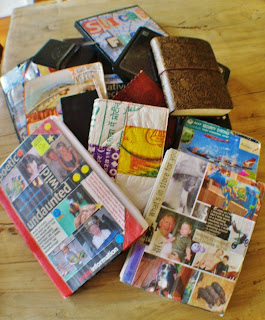
When searching for mentor samples or craft examples you might consider this. Gather some of your favourite books in a pile. Then, select a random page number (I chose 23) and open each book at that exact same page and let your eyes rove the page carefully in search of those special words that catch your attention and generally appeal. Record what you are drawn to. Write the words you find straight into your notebook or your computer, if you prefer. Look at the assembled words carefully and let your writer’s eye take over. Notice the words, the craft, the language structure. We are merely practicing the art of reading like a writer. You might actually find some pearls in your word search. Pearls you can put to further use in your important work as a teacher of writing. Remember, not everyone who wanders is lost. We are afterall, explorers. My Notebook Entry: ‘Everything has a value, Provided it appears at the right time in the right place. It’s a matter of recogniz...

BRAINSTORMING With Stenhouse Publishing

Image
I woke this morning to some great news!  My article on brainstorming previously posted by Two Writing Teachers earlier this year, has been picked up by Stenhouse Publishers in their latest Newslinks. Like me, you can subscribe to Newslinks which is free and provides lots of great professional support with writing, reading and numeracy. If you missed the original article, or are interested in reading about assisting young writers to more effectively generate ideas for writing then go to Stenhouse Newslinks at: http://www.stenhouse.com/html/nl227.htm  or you can link to the article at  Two Writing Teachers: http://twowritingteachers.wordpress.com/2011/05/20/wright/ Tenielle's Brainstorming Ideas when thinking about her Aunt

Some Issues Around the Writer's Notebook

Image
Writer Joan Didion said our (writer’s) notebooks give us away. We are revealed by the contents. Our notebooks are a place to collect and then take those collected items and use them to spark further original writing. As Ralph Fletcher, writer and educator reminds us, we use our notebooks to breathe in (collect) and breathe out (generate). With these thoughts ringing in my ears, I envisage notebooks brimming with words and ideas across a range of subjects and genres. The notebook is a place to experiment, take risks, make important discoveries or excavate memories and ideas from deep within. It can be a place to have fun with words. So why is it that in many classrooms when students take out their notebooks the pages reveal a picture far removed from the images I have just outlined?    Why does one get the impression that the notebook in these school settings is only realizing a small part of its potential? Why is the critical ingredient –‘writing,’ so sadly lac...

The Silent Share Time- A Writing Idea From Deb Day

Image
In her recent guest blog hosted by Two Writing Teachers   on September 2, Deb Day, shared a wonderful idea for adding variety to share time. I thought it was so good, I am ‘sharing’ it with you. Deb Day has been teaching English and reading classes in northeast Iowa since 1989. In her current position she teaches speech , creative writing , ninth grade English, and coaches contest speech. Her blog about teaching and her life   is called Coffee With Chloe . ‘This year I want to share more and in several different ways. A favorite with past students has been the “silent share.” I’ve noticed students seem to have trouble sharing their writing aloud. So in silent share, I have students lay out their writing around the room, with or without their name. The class then goes around the room with post-it notes and reads at least three pieces. They write their comments on the notes and stick them to the piece when they are done reading. Gradually, as students become more comfor...

A Variety of Powerful Voices Assist Young Writers

Image
Last week I wandered into ‘ Enchanted By Books ’, a specialty book shop in the Melbourne suburb of Williamstown.   http://www.enchantedbybooks.com.au/    It is one of three book stores, I have so far discovered in Williamstown. The shop caters for readers 0 -14 and has a select collection of fiction and non fiction titles.   It was another chance to browse and seek out books suitable for teaching aspects of writing. Some time later I walked out with three great titles I firmly believe will assist me to more effectively teach young writers about   ‘voice’ These vastly different books have much to ‘tell’ us about voice in writing.   -A concept often difficult for students to incorporate into their writing. I found Anthony Browne's cleverly constructed picture book, Voices in the Park , Doubleday, 1998,   where the author uses inventive voice and vision to create four interrelated tales based arou...

Assisting Young Writers to Embrace Revision

Image
All too frequently a teacher will inform me that their students passively resist revision as a tool for improving their writing. Their students are yet to understand that ‘revision is the magic behind great writing.’  If we, as teachers of writing want students to embrace the idea of revision we must remove some very obvious obstacles that may be getting in the way of real revision. Let’s begin with topic selection!   When students are able to choose what they really want to write about, then they usually display increased commitment to producing their best writing. As a consequence, they indulge in their best revision efforts. If the teacher owns the topic, the idea, the response, the student experiences a disconnection from the piece. Allowing students to choose topics is central to the philosophy of  an authentic writing program. If students feel a sense of passion about what they’re writing, revision is more likely to be viewed as int...

Web 2.0 Writing and Education

Image
This post comes courtesy of Lindsey Wright , a guest blogger to Living Life Twice. Welcome Lindsey! Lindsey is fascinated with the potential of emerging educational technologies, particularly the online school, to transform the landscape of learning. She writes about web-based learning, electronic and mobile learning, and the possible future of education and its potential for writing. 'From hieroglyphics to blogs, humans have always had a need for written communication. Evolution and technology have made use of the written word increasingly complex. The rise of Web 2.0 has brought about a major shift in the media through which people communicate. Consumers of media are now increasingly the producers of media. Writing has become the fundamental skill essential to surviving in a globalized, Internet-based society. Writing is the basis for Web 2.0 participation and contribution and has become one of the most important skills learned in school. Scholars Sean Wiebe and Sandy McAu...

Have Students Read Their Writing Aloud When Revising

Image
If we purposefully teach student writers the habit of  ‘rereading’ their writing, we provide them with a powerful tool for improving the quality of their writing. This reading includes, rereading as they draft,   and rereading as part of revision. They begin to hear their words as a reader will hear them. It provides powerful feedback.   When drafting a piece of writing the developing writer is commonly driven by the production of words across the page. The urgency surrounds the act of writing,  so the writer is not necessarily focusing on what the words are ultimately saying. The result is often- too many words or too many ideas. The writing may lack focus.  A decision is required at this point. What exactly do I want my words to say and mean?   It may be difficult to throw away words considered precious. Remember though, each word cut from the text may lead to preserving the energy of the overall piece. The writ...

Assisting Students to Appreciate SMALL MOMENTS in Time When Writing

Image
The stories we tell others and eventually write about often emerge out of small moments, in which there is only time enough to perform a brief task or action. Think of things that happen in your life that, while taking only a moment of your day, assume great significance. One way to begin teaching inexperienced writers to appreciate the power of ‘small moments is to read aloud a small extract from a book. A carefully chosen excerpt can help children better understand what it means to write about a small moment within a bigger story. To slow down the action and meander about in the moment. The writer may also attach importance to a small moment to build tension and illustrate the significance of the event to the overall story. Writers don't apportion the same amount of attention to every detail within the story. The story ebbs and flows. The writer controls the speed and the attention given to various aspects of the story.   Chris Van Allsburg is skilled at focus...

Initiating Conversations About The Teaching of Writing

Image
Is it time for a discussion around how writing is taught in your school? Is there a lingering concern that maybe things could be done differently, better? I have used the following questions on a number of occasions to initiate critical conversations around writing. Feel free to adopt or adapt them to suit your particular circumstance. The aim is to provoke those essential conversations: What are some of the structures, rituals, and routines that are present in successful school based writing programs? What are the critical considerations when scheduling adequate time for writing and writing instruction? What does good writing look like and sound like? What are some of the important things writers do that could be shared with your students? Do you currently share your writing with your students? Why or why not? If teachers were to write alongside their students, sharing and taking risks with their own writing- How mig...