Posts

Nudging Writers To Make A Choice

The Stenhouse Blog: Quick Tip Tuesday: Nudging kids to make a choice  'Nonfiction reading, research, and reporting is hard work. For students to maximize their inquiry experience, they should choose a topic they care about, know something about, and wonder about,' writes Stephanie Harvey in her book Nonfiction Matters: Reading, Writing, and Reseach in Grades 3-8. But some students find it difficult to pick a topic or they think that their hobbies and interests are not suitable for school. In this Quick Tip, we get a quick glimpse into a conversation between a student, Thomas, and his teacher, Mary, as they talk about Thomas’ interest in football and how that will make a great topic for his research paper. Some students struggle with topic selection. On the eve of the topic deadline, Thomas had not come up with a single idea for research. His mother rang Mary first thing in the morning and described a family in turmoil. Thomas had been up all night fraught with anxiety ov...

The Power of Memoir: Kimberly Hill Campbell, Stenhouse Blog

Everyone has a story to tell. In this installment of  Stenhouse Publishers, Questions & Authors series, Kimberly Hill Campbell shares some great memoirs , followed by some ideas that support writing a memoir. Kimberly’s recent book Less Is More: Teaching Literature with Short Texts, Grades 6-12, explores a variety of short texts to engage a wide range of young writers. Enjoy! The Power of Memoir This fall I was asked by one of the graduate students in my language arts methods class to explain the difference between personal narrative and memoir. And I immediately thought of the personal narratives so many of my high school students had written. Stories of experiences that were often rich in detail but missing what I so appreciate about memoir: the why of the personal story. Personal narrative is the starting point for memoir, but it is in the selection of what to include and what it all means, that we move from narrative to memoir. As William Zinsser, ...

Choice in Sharing by Ruth Ayres

This post comes from Ruth Ayres, Two Writing Teachers. Ruth writes about how she wants to manage share time at the conclusion of her writing workshops. Share time is such a valuable sharing opportunity. Ruth's observations and ideas are well worth considering... Posted on Wednesday August 25, 2010 by Ruth  Ayres, Two Writing Teachers Robert B. Parker. There is no one right way. Each of us finds a way that works for him. But there is a wrong way. The wrong way is to finish your writing day with no more words on paper than when you began. Writers write. Every August, I think about what area in regards to teaching writing that I want to pay particular attention to. This year my focus is CHOICE. Something that has caught my attention the past two weeks has been giving kids more say in the sharing time of writing workshop. This has been a time when I’ve often been specific in my directions for sharing time. I’ve said things like: Share the lead of your story with the class. ...

Writing and Wondering

Image
I have been buying magnifying glasses lately. I want my grandchildren to have one each so that they can discover and celebrate natural wonder. I recall how much fun I had as a small boy with my own magnifying glass. –Seeing snails and slugs up close, or watching ants and noticing their fine feelers, or exploring nature’s wonders in the fine lines and patterns on leaves. There was for me, a fascination observing the world through this magic portal; this round window. I want the natural curiosity my grandchildren possess further stimulated by the experience of seeing small wonders up close and personal. I hope such a simple gift as a magnifying glass stimulates their imagination and creativity. I hope they respond with wonderment and awe. A magnifying glass is not a piece of cutting edge techno wizardry, but it is a powerful tool for determining answers to questions that spring from every day experiences. Seymour Simon said ‘ I’m more interested in arousing enthusiasm in kids than in t...

Writing Ideas: Photograph Your Small Treasures

Image
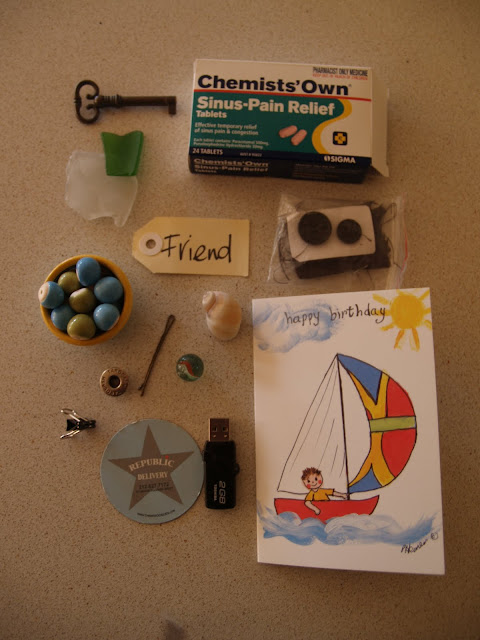
Invite your students to gather some small artefacts from around the house. Have them arrange the gathered items in a pleasing design, then when satisfied that the items are clearly presented- take a photograph. These simple items form a pictorial topic list that writers may delve into. Each one has its own unique story just waiting to emerge. If your students don't have access to a camera have them bring the selected items to school and do the snapping there! This is a wonderful stimulus for promoting talking and thinking about wriitng intentions. try it yourself first and share your discoveries with your students. Show them the writing that springs forth. The photo above repesents my quick household gatherings. The writing that follows sprung from scanning and thinking about the assorted items. Sea Glass The beach is not a place to labour Too warm and damp And soft Never a place to conjure flights of fancy It rises against one’s m...

Effective Writing Instruction -Do You See What I See?

Image
When one steps into a Writing classroom it is implicit that the following components be present in the structure of the writing workshop: Instructional Groupings Whole Group • Teacher demonstrates a writing strategy or skill using either a mentor text and/or their own writing. • Anchor charts are created (with student input) as resources to support writing development. • Students engage in meaningful conversations around their writing, using think/pair/ share, turn and talk, peer conferences etc. • Adequate time is provided for writing rehearsal and review and reflection. • Explicit links are constantly made between reading and writing. • Writing tasks undertaken are purposeful and authentic. Independent Work • Students actively engage in writing tasks or confer with peers or the teacher. • Students may read and/or research as they explore aspects of a particular genre or craft strategy as part of the inquiry of text structures and features ...

Melbourne Writers Festival Schools Program

Image
Just sharing the news regarding the upcoming Melbourne Writers Festival Schools Program. Think about those young writers who have exhibited special talent and interest and let them know about this opportunity. Go to: http://www.mwf.com.au/2010/content/mwf-2010-standard.asp?name=Schools-program

NEWS: Top Ten Writing Blogs for Teachers Announcement

Image
I am pleased and somewhat pleasantly surprised to learn that Living Life Twice , this humble little effort to raise the profile of writing has been named number three in a list of the Top Ten Blogs for Writing Teachers. The list was compiled by Maria Magher for  On Line Degree Course Site. The list contains some useful support information you may wish to access. It is included in the Top Ten List of Blogs for writing teachers. I invite you to check it out at  http://www.onlinedegrees.org/top-10-blogs-for-writing-teachers/

The Chance to Rant About An Issue

Stacey Shubitz, from Two Writing Teachers , posted this and given the fact that next year's NAPLAN focus for writing is persuasive text, this idea has some relevance... Stacey Writes: My afternoon session, “Writing from the Heart: Finding Your True Voice,” at the TCRWP Writing Institute was taught by James Howe (aka: Jim). During the course of the week Jim provided us with a variety of writing exercises, which lasted from 5 – 20 minutes, to help us write from the heart. One of the many exercises he gave us was: Use a news story you’ve connected with emotionally to see where it takes you. I didn’t bring a newspaper with me that day, but I did bring my iTouch, which has The New York Times App on it. I went to my saved articles and found one that resonated with me several months earlier. I found myself writing non-stop about Samuel G. Freedman’s “A Jewish Ritual Collides with Mother Nature,” which is an article that elicited a strong reaction from me when I read it months ear...

Charting Our Progress -Using Anchor Charts

Image
Anchor charts are important tools for students to use during Writers' Workshop and aid them in remembering procedures, craft strategies,ideas and expectations. When teachers co create such charts with their students, the students frequently develop a sense of ownership because the recorded information reflects their ideas, their language. Once constructed, charts can be copied in a smaller format for students to place inside their writer’s notebook or writing folder as a further point of reference. Charts should be added to over time. This reinforces the fact that knowledge grows across time and space as we investigate and discover. Anchor charts should be removed when no longer needed. They could stored as flip charts. Anchor charts need to be posted in the classroom where they are easily accessible to students in order to serve as a resource for their writing. Teachers who develop anchor charts with their students and refer back to said charts frequently throughout writer's ...