Wednesday, September 14, 2011

Some Issues Around the Writer's Notebook
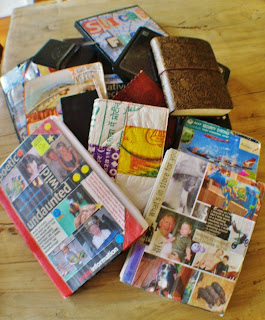
Writer Joan Didion said our (writer’s) notebooks give us away. We are revealed by the contents. Our notebooks are a place to collect and then take those collected items and use them to spark further original writing. As Ralph Fletcher, writer and educator reminds us, we use our notebooks to breathe in (collect) and breathe out (generate).

With these thoughts ringing in my ears, I envisage notebooks brimming with words and ideas across a range of subjects and genres. The notebook is a place to experiment, take risks, make important discoveries or excavate memories and ideas from deep within. It can be a place to have fun with words.

So why is it that in many classrooms when students take out their notebooks the pages reveal a picture far removed from the images I have just outlined?   Why does one get the impression that the notebook in these school settings is only realizing a small part of its potential?

Why is the critical ingredient –‘writing,’ so sadly lacking as to be almost missing in action? Content is so critical to the developing writer and yet the writer’s notebooks in these contexts, lack integrity because they’re not being used to generate authentic writing.

What does one see documented in these notebooks? Well, usually it’s limited to such entries as pictures, artifacts, lists, Y charts, plans, graphic organizers, but very little genuine writing! A closer examination of the few notebook entries reveals the sad fact that the entire class is frequently writing about the one same topic in exactly the same way. The teacher’s topic reigns supreme! The writer’s notebook takes on the appearance of a stage managed planning book, rather than a place to write. Some student notebook look like scrapbooks, and it is obvious that ‘writing’ is not the major focus of these stylized, stilted and overly managed creations.

The name says it all really- it’s a writer’s notebook! It may contain elements of scrapbooks, sketchbooks, diaries, or journals, -but at the end of the day, it is the writing that is the critical component.

I have been told on numerous occasions, ‘This is where my students do their thinking. They do their writing in a writing draft book!’ Why the dis-connect?

I have always believed that it is in my writing that I reveal my thinking and if I have a writer’s notebook, why do I need a writing book? It seems redundant.

Student writers certainly benefit from having a writing folder. When the time comes to lift a piece from the notebook for further ‘developing’ a folder provides the freedom for writing to spread and expand across several pages if necessary. The writer has the option to cut and paste and generally move the writing about.

Some teachers encourage student writers to leave a blank page opposite the writing page in their notebooks. -The aim here is to allow students the option of adding additional information, changes and the like. This idea works because it is about growing the writing.

I could espouse a theory as to why this situation has developed, but I want to focus on possible solutions rather than further examination of the problem at this time. So

·         How do we maximize the potential of the writer’s notebook?
·         How do we improve the situation for student writers and their teachers?

I propose the following actions to preserve the integrity of the writer's notebook:

  • Increased professional reading about writing. Books such as Ralph Fletcher’s Breathing In, Breathing Out, Keeping A Writer’s Notebook, or Aimee Buckner’s, ‘Notebook Knowhow’ provide a great insight into using notebooks. That’s a start.
  • Increased use of the writer’s notebook by teachers. We learn by doing. For the notebook to be truly impactful, it requires teachers willing to embrace it. --Risk taking educators who lead the way forward for the young writers seeking direction. The notebook is not just another thing we make students do.
  • Sharing notebook entries provides further insight as to how a notebook might look. Let the sharing begin!
  • Strengthen the reading writing links. Embrace literature as a tool for teaching writing. Teachers of writing are not alone. Mentors await discovery.
  • Teach students how to harvest ideas for writing. This requires the teacher to discover where ideas reside and then share these places with their students. A simple place to start is your own life, books, places, people, pictures, photographs, media, events…
  • Allow students some choice in the configuration of their notebooks. One size doesn’t fit all. I have notebooks of various sizes to suit various situations.
  • Use the notebook to make lots of ‘starts’ before choosing one special piece that may be lifted out of the notebook and developed further.
  • Make the notebook a place for the writer to experiment, collect, and wonder through writing.
  • Encourage students to fill the pages of their notebooks with words and ideas. Let them follow your lead as a joyfully literate educator.
  • Encourage students to take their notebooks out into the world beyond their classroom. Set the notebooks free!
Let’s remove the unnatural impediments to writing. Teach into the notebook through our actions as writers and teachers. Then watch the writing take off and the notebook realize its true potential as a resource.

I would love to hear your views and suggestiions on this issue.

Tuesday, September 6, 2011

The Silent Share Time- A Writing Idea From Deb Day

In her recent guest blog hosted by Two Writing Teachers  on September 2, Deb Day, shared a wonderful idea for adding variety to share time. I thought it was so good, I am ‘sharing’ it with you.
Deb Day has been teaching English and reading classes in northeast Iowa since 1989. In her current position she teaches speech, creative writing, ninth grade English, and coaches contest speech. Her blog about teaching and her life is called Coffee With Chloe.

‘This year I want to share more and in several different ways. A favorite with past students has been the “silent share.” I’ve noticed students seem to have trouble sharing their writing aloud. So in silent share, I have students lay out their writing around the room, with or without their name. The class then goes around the room with post-it notes and reads at least three pieces. They write their comments on the notes and stick them to the piece when they are done reading. Gradually, as students become more comfortable with each other, I will work toward more public sharing of drafts and snippets of long pieces.’

To read more about Deb Day’s ideas for teaching writing go to
 http://deb-day.blogspot.com/

Monday, September 5, 2011

A Variety of Powerful Voices Assist Young Writers

Last week I wandered into ‘Enchanted By Books’, a specialty book shop in the Melbourne suburb of Williamstown.  http://www.enchantedbybooks.com.au/   It is one of three book stores, I have so far discovered in Williamstown. The shop caters for readers 0 -14 and has a select collection of fiction and non fiction titles.  It was another chance to browse and seek out books suitable for teaching aspects of writing. Some time later I walked out with three great titles I firmly believe will assist me to more effectively teach young writers about  ‘voice’ These vastly different books have much to ‘tell’ us about voice in writing.  -A concept often difficult for students to incorporate into their writing.

I found Anthony Browne's cleverly constructed picture book, Voices in the Park, Doubleday, 1998,  where the author uses inventive voice and vision to create four interrelated tales based around the setting of the park. Browne describes their version of the events, altering light, colours and words. Browne also changes font to further reinforce the difference in narrating voice. The benefits in having students note the contrasting voices and how they contribute to the overall voice of a piece are most obvious. Browne’s characters reveal themselves through their words.

‘You get some frightful types in the park these days’ ( First Voice)

 'I settled on a bench and looked the paper for a job. I know it’s a waste of time really, but you’ve got to have a bit of hope, haven’t you?’ (Second Voice)

 ‘D’you wanna come on the slide?’ a voice asked. It was a girl unfortunately, but I went anyway. She was brilliant on the slide, she went really fast. (Third Voice)

 ‘I got talking to this boy. I thought he was a bit of a wimp at first, but he’s okay. (Fourth Voice)

 Students are more likely to begin experimenting with voice in their own writing. They may begin to look at how their favorite authors distinguish themselves and compare one author's style to another.  I can see much potential for teaching young writers about voice using this rich text.

The second book I purchased was Martin Jenkins and Vicki White’s non fiction title, ‘Can We Save the Tiger?’ Walker Books UK, 2011.  What distinguishes this book from many non fiction titles was the sense that the author was talking directly to me; the reader. I got the impression the author was indulging in a personal conversation with me. There existed an intimacy in the words. The author could well have been whispering in my ear with words like these:

‘The world’s quite a big place, you know…’

Still, I’m sure you’ll all agree that tigers are pretty special’

‘Or…I could go on and on. And I think that would be a shame, don’t you?’ (regarding the plight of various animals)

 These personal words are interspersed with factual data about respective endangered species, labels and detailed illustrations by Vicki White. The book also uses a variety of fonts and font sizes to draw attention to the messages in the text. What distinguishes this book from many non fiction texts is the narrator’s voice. It is neither detached or impersonal. There is a conscious attempt to speak directly to the reader. The voice shines through.

The final book in my bag was, ‘I Won’t Say Please’ written by Mij Kelly and illustrated by Ruth Palmer, Koala Books 2002. –a cautionary tale about a Queen Bee who is having a bad day and refuses to apologize for her lack of good manners. The book cleverly reveals the characters through rich exchanges of dialogue. The use of voice is self evident here, but it has much to teach young writers about effective use of speech in a text. The voices are clearly defined through exchanges such as:

‘Fetch me my clothes and my crown’

Look here, Queen Bee, You don’t have to beg or get down on your knees, but you could at least say please.’

‘Why should i?’

And later…

‘You see, Queen Bee, I shan’t make your breakfast until you say please.’

‘Oh go and hide your head!’ Queen Bee said.

Like the previous titles, this picture book uses a variety of font sizes to emphasize tonal differences.  

‘I feel stung! She wailed and moaned.

My new books will add to my growing collection of mentor texts. -Texts that serve to show students how to write well.  -Texts carefully chosen to illuminate craft elements (in this instance, voice) in a variety of ways. Using conversation and observation and my personal writing, I will utilize these wonderful books to strengthen the natural connections between reading and writing.


.


Sunday, September 4, 2011

Assisting Young Writers to Embrace Revision

All too frequently a teacher will inform me that their students passively resist revision as a tool for improving their writing. Their students are yet to understand that ‘revision is the magic behind great writing.’  If we, as teachers of writing want students to embrace the idea of revision we must remove some very obvious obstacles that may be getting in the way of  real revision.


Let’s begin with topic selection!  

When students are able to choose what they really want to write about, then they usually display increased commitment to producing their best writing. As a consequence, they indulge in their best revision efforts. If the teacher owns the topic, the idea, the response, the student experiences a disconnection from the piece. Allowing students to choose topics is central to the philosophy of  an authentic writing program. If students feel a sense of passion about what they’re writing, revision is more likely to be viewed as integral to the process of producing something worth reading.     

The Principle of Purpose
                                                                                                                                                         
The writing our students are doing must have a real and obvious purpose. It is critical that the writing has an authentic purpose. It must be linked to the idea of ‘audience.’ Who are you writing this for? Who are your readers? Where will this be read?  Where is the writing going next? Without a reason to write there is little point being invested in the effort required to write it. It saddens me to hear students respond, ‘Its for my teacher’ when I ask them who the writing is for. As teachers we need to invest a lot of time in establishing an awareness of audience in writers. This implies publishing and a range of audiences. This is where purpose resides… As teachers we need to be more creative than merely pinning the writing up on the walls of the classroom. Taking writing beyond the school is critical. When writing goes public, it leads to feedback. This leads the writer back to the purpose and value of revision. 

Is this Editing or Revision?

If we as teachers are confused about these processes then it will hamper the level of revision that occurs. If students just ‘fix up’ the surface features of the writing (spelling, grammar, punctuation) they are not revising the piece, they are editing. Revision requires the writer to re-vision the writing. This means revisiting the content and working to improve the way it is written. The writing is re-crafted not just fixed up. Sometimes this may involve surgery, cutting and pasting chunks of text. Young writers need to be shown how to do this.

Did I Mention Mentors?   

All young writers need regular contact with someone willing to share their writing at all stages of the writing process. Students need to see how another writer uses revision to improve the content of their writing. This is the action that most effectively breaks down the resistance to revision. Its up to the most proficient writer in the class to demonstrate how revision works for them as writers.