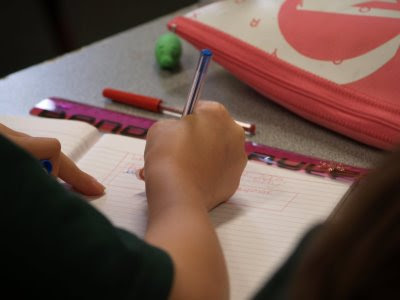
I found myself talking to a group of enthusiastic grade one students who were keen to commence their writing pieces. As they stood up from the carpet to return to their seats to commence their writing, I realized that the spark of imagination that would fire my writing ideas had suddenly snuffed out. The students all seemed fired up and ready to create the miracle of meaningful marks on paper. I felt completely blank and could not conjure up a single thing to write about. I was trying to will my brain into action. Writer’s block had descended upon me like a damp,foggy mist
A boy stood beside me at this critical moment and said, “I’m going to write about the first time I went fishing which was on Saturday with my Dad”
“Oh thank you” I said and uttered a huge sigh of relief.
The bemused child looked at me unsure what he had done.
“You just gave me a wonderful idea for my writing this morning. Like you, I’m going to write about the very first time I went fishing. Maybe we can share our stories at the end of this writing session?”
“Okay,” he said and wandered away to begin his writing piece.
Our exchange was as simple as that, but suddenly I was visited by such a strong visual image of that first fishing adventure with my uncle at Blackburn Lake and the associated thrill of catching three redfin. I was back there again reliving the moment.
That brief exchange with a fellow writer underscored the critical nature of talking to fellow writers. - The free exchange of ideas. A fellow writer’s words had sparked an idea for my writing at a time when I was seeking inspiration. That critcal conversation assisted me to discover my writing direction.
Saturday, October 25, 2008
Sunday, October 19, 2008
Writing About Issues -Big and Small
I spent some time during the recent September term holiday scanning newspapers, magazines and the Internet for articles related to current issues in the news. The issues covered everything from local, to state, to national and including, global issues. I had to choose articles that had some significance to sixth graders as they were the target audience. Issues ranged from articles on adolescent health, use of mobile phones among children, world poverty, environmental degradation of the coral reef, to endangered animals, to supermarket levies on plastic bags, to the effects of global warming. I needed a minimum of ninety articles as I was working across three Grade 6 classes at Karoo Primary School in Rowville, Victoria. As you can imagine, I spent quite some time hunting and gathering these pieces.
Students were asked to read an article that attracted their interest. Following this, they were asked to identify the issue, and then identify what their personal stand was with regard to the issue. The next step was to talk to at least three of their classmates regarding their respective issues. They were encouraged to ask questions of each other and to take notes as they went about their discussions.
I then shared the written responses I had recorded in my writer’s notebook in response to various news articles. The aim was to have them notice that I had recorded my point of view, my position on each the issues -public transport, sun protection for school students, and the teaching of social skills in schools. I drew their attention to the fact that I had not recounted the facts contained in the article. I had in fact written in response to the issues outlined in each of the pieces. This distinction was important.
I then invited the students to undertake the same approach to the articles they had selected. I informed them that I was greatly interested in their individual opinions on these issues. I wanted them to discover their voice as writers.
I was able to observe as they keenly wrote up their responses. They wrote freely, and with stamina for the task. I conferred with them and was struck by their understanding of the issues under consideration and the sense of voice that emerged as their words filled the page.
During the share time I noticed that they had no difficulty establishing their respective opinions on a range of issues. Many were keen to offer possible solutions to many of the problems. The talk was vibrant and meaningful. The ability to articulate a position on an issue was most evident. I asked them what they had discovered about themselves as writers and the issues being reviewed.
Some were pleasantly surprised by how much they actually knew about particular issues. The amount of writing generated surprised a number of the students. Others wanted to discover more and write about it. One girl found herself on the horns of a dilemma. She could see both sides of the issue and was still undecided. This was valuable reflection.
The teachers of these world aware students, Kym Robinson, Lindsey Bates and Erin Harman are to be congratulated. They have done much of the work that has underpinned the progress these students have made. Their guidance and high expectations of themselves and their students, have brought about effective learning outcomes. These students are able to write with confidence across a range of genres and have developed that essential world knowledge to launch themselves higher and further as writers and thinkers.
Labels:
Issues,
Opinions,
Persuasive Essay
| Reactions: |
Friday, October 17, 2008
Grammar In Isolation Never Works For Writing
As recently as 2005, Professor Richard Andrews of York University conducted the largest systematic review of existing studies on the teaching of grammar and found there was no evidence that teaching grammar as a formal stand alone exercise helped 5-16 year old write more fluently, or accurately.
It is therefore surprising that news reports indicate the proposed Australian national curriculum will be reviving the practice of formal grammar. As a result, media headlines scream the tired old catch cry ‘back to basics’ and the conservatives among us salivate. I see red every time the headlines scream ‘Back to Basics’. Teaching the so called basics has never gone away. Teachers confront the basics on a daily basis. It is at the core of what they do. It is insulting to suggest that re-inventing the past is the way to go. Suddenly, educators need to cast their collective eyes backwards with regards to spelling, grammar and phonics. Gee, thanks for that.
This is not to say that the teaching of grammar has no value. It’s just that there are better ways to teach grammar than the way apparently being proposed.
Contextualising grammar assists students to understand the role that grammar plays in developing as an effective writer. It teaches students to produce writing that is ‘reader friendly.’ What it doesn’t do is divorce grammar from the actual act of producing writing. However, what also needs to be present in our curriculum planning is the awareness of the need to teach students to be meta-cognitive with respect to the writing they produce. Grammar alone just won’t cut it.
Metacognition and Writing Development
Talk, as we have come to learn, plays a crucial role in learning to become a literate being.
Research conducted by Sharples (1999) argues that the ages of 10-14 are crucial, as at this stage children begin to be able to talk about how they write, rather than about what they have written,. This is a critical distinction and has clear implications for the way we teach writing.
Other researchers such as Kellog (1990) advocate the need to teach metacognitive awareness. Englert et al, used talk as a tool for making the writing process overt and found a positive correlation between metacognitive knowledge and writing performance, particularly in the students’ ability ‘to articulate their knowledge of structures, how to group ideas and knowing when a piece of writing is complete.’
In discussing meta-cognition, it is argued that the importance of students gaining increased mastery over the language of the writing process cannot be over-emphasised. These research findings are
signalling the importance of a meta-language, though it is not necessarily grammatical language. It suggests young writers need more.
The debate regarding grammar crosses this area. The question arises,-Is the ability to control and manipulate the material at hand more significant than the ability ‘to describe a linguistic feature using grammatical terminology?
We know that explicit teaching of grammatical rules is not necessarily matched by an ability to make corrections. There is no simple relationship between explicit rules and corrections.
Interestingly, Carter’s research (1990) found that the demise of formal grammar teaching and with it the absence of a meta-language in the classroom has been disempowering, preventing learners from ‘exercising the kind of conscious control and conscious choice over language which enables students to see through language in a systematic way and to use language more discriminatingly’.
Looking into the relationship between grammar and writing indicates as Professor Richard Andrews observed, ‘There is still a dearth of evidence for the effective use of formal grammar teaching in the development of writing’.
Any debate about grammar that discards the realities we face in the classroom is not going to be of much value. What we need is a debate that takes seriously the connection between writing and thinking.
It is therefore surprising that news reports indicate the proposed Australian national curriculum will be reviving the practice of formal grammar. As a result, media headlines scream the tired old catch cry ‘back to basics’ and the conservatives among us salivate. I see red every time the headlines scream ‘Back to Basics’. Teaching the so called basics has never gone away. Teachers confront the basics on a daily basis. It is at the core of what they do. It is insulting to suggest that re-inventing the past is the way to go. Suddenly, educators need to cast their collective eyes backwards with regards to spelling, grammar and phonics. Gee, thanks for that.
This is not to say that the teaching of grammar has no value. It’s just that there are better ways to teach grammar than the way apparently being proposed.
Contextualising grammar assists students to understand the role that grammar plays in developing as an effective writer. It teaches students to produce writing that is ‘reader friendly.’ What it doesn’t do is divorce grammar from the actual act of producing writing. However, what also needs to be present in our curriculum planning is the awareness of the need to teach students to be meta-cognitive with respect to the writing they produce. Grammar alone just won’t cut it.
Metacognition and Writing Development
Talk, as we have come to learn, plays a crucial role in learning to become a literate being.
Research conducted by Sharples (1999) argues that the ages of 10-14 are crucial, as at this stage children begin to be able to talk about how they write, rather than about what they have written,. This is a critical distinction and has clear implications for the way we teach writing.
Other researchers such as Kellog (1990) advocate the need to teach metacognitive awareness. Englert et al, used talk as a tool for making the writing process overt and found a positive correlation between metacognitive knowledge and writing performance, particularly in the students’ ability ‘to articulate their knowledge of structures, how to group ideas and knowing when a piece of writing is complete.’
In discussing meta-cognition, it is argued that the importance of students gaining increased mastery over the language of the writing process cannot be over-emphasised. These research findings are
signalling the importance of a meta-language, though it is not necessarily grammatical language. It suggests young writers need more.
The debate regarding grammar crosses this area. The question arises,-Is the ability to control and manipulate the material at hand more significant than the ability ‘to describe a linguistic feature using grammatical terminology?
We know that explicit teaching of grammatical rules is not necessarily matched by an ability to make corrections. There is no simple relationship between explicit rules and corrections.
Interestingly, Carter’s research (1990) found that the demise of formal grammar teaching and with it the absence of a meta-language in the classroom has been disempowering, preventing learners from ‘exercising the kind of conscious control and conscious choice over language which enables students to see through language in a systematic way and to use language more discriminatingly’.
Looking into the relationship between grammar and writing indicates as Professor Richard Andrews observed, ‘There is still a dearth of evidence for the effective use of formal grammar teaching in the development of writing’.
Any debate about grammar that discards the realities we face in the classroom is not going to be of much value. What we need is a debate that takes seriously the connection between writing and thinking.
Wednesday, October 15, 2008
Visual Imagery -Great for Mind Movies!
In the course of twenty four hours I received emails from two mates in vastly different parts of the world. Colin Murray wrote about an experience en-route to Budapest to conduct teamwork and safety training for oil workers. Chris Lowery wrote about his wonderful vacation experience on the Trans Siberian railway, an epic journey that took him from Moscow to Beijing. I was immediately struck by the strong visual imagery both writers conveyed through their choice of words.
Colin in the course of explaining his in flight experience wrote:
“My flights here were sprinkled with the usual array of personalities. From Singapore to Frankfurt, a mere 13 hours, I had a stick insect perched next to me. She came from India I suspect and was facially quite beautiful. She was also stunningly slim. She arrived onboard quite late, had no carry-on save a miniscule plastic bag, sat mantis-like in the seat next to me, said nothing, ate nothing, drank nothing, moved minimally and simply slept in the linear position. She didn’t even shed shoes or jacket. She must have had a caste-iron bladder or perhaps she was in hibernation!
Of course the yin and yang prevails as across from me was her complete counter-balance a florid gargantuan in a floral tent and white matador pants. She resembled an ocean liner. She simply ate her way to Frankfurt. She consumed vigorously and sought yet more helpings with that ever-so-well known ‘call of the porker’ - “Yes please … but just a small portion”. As I dosed breezy sensations told me Miss Pudding Bowl 1975 had hoisted herself out of her seat and headed for the loo. An image started to develop but I squeezed my eyes shut and let furtive sleep reclaim me…”
Chris related part of his epic train journey and the places encountered along the way:
“…Nauski. Now there’s a place. This hot dump in the middle of nowhere where you are required to sit around for three hours while the trains convert the gauges is borderline unbearable. No shade. No cold drinks. Filthy beyond recognition. Utterly forgettable. Listening to Lyrnryd Skynryd and reading an old Classic Rock for the sixth time was my one relief .We are now on the train and sitting patiently waiting for the guards to inspect our visas and passports and it is heating up. The train is air conditioned, but poorly so, and only when we are in motion. Who said travel was all souvenirs, sights and vodka?”
Chris as part of his journey also visited the Great Wall of China:
“I gazed over the foggy mountaintops at the snaking wonder on the Great Wall trailing off in the distance and tried to imagine how it was physically possible to get those stones up the mountainsides to make such an impressive structure. How many must have died completing the only manmade object observable from space? I daydreamed and just sat and stared for a full 30 minutes. Not one other soul in sight – apart from a silent guard at each vantage point along the trail. Just gold and time to let the imagination of the ancient Chinese Dynasties, wash around me.
Both Colin and Chris are adept at using words to paint a scene in the minds of their readers. Thank you both for shining a light through the window of your respective lives. Great mind movies to savor. I have been reading as a writer here and that has further enriched my reading. Visual imagery, created through strong descriptive writing.
Whether you are bound for Budapest, traveling the Trans Siberian Railway, or like me currently sitting at my desk, you can take your readers with you if you remember your readers need to be able to visualize your words.
Colin in the course of explaining his in flight experience wrote:
“My flights here were sprinkled with the usual array of personalities. From Singapore to Frankfurt, a mere 13 hours, I had a stick insect perched next to me. She came from India I suspect and was facially quite beautiful. She was also stunningly slim. She arrived onboard quite late, had no carry-on save a miniscule plastic bag, sat mantis-like in the seat next to me, said nothing, ate nothing, drank nothing, moved minimally and simply slept in the linear position. She didn’t even shed shoes or jacket. She must have had a caste-iron bladder or perhaps she was in hibernation!
Of course the yin and yang prevails as across from me was her complete counter-balance a florid gargantuan in a floral tent and white matador pants. She resembled an ocean liner. She simply ate her way to Frankfurt. She consumed vigorously and sought yet more helpings with that ever-so-well known ‘call of the porker’ - “Yes please … but just a small portion”. As I dosed breezy sensations told me Miss Pudding Bowl 1975 had hoisted herself out of her seat and headed for the loo. An image started to develop but I squeezed my eyes shut and let furtive sleep reclaim me…”
Chris related part of his epic train journey and the places encountered along the way:
“…Nauski. Now there’s a place. This hot dump in the middle of nowhere where you are required to sit around for three hours while the trains convert the gauges is borderline unbearable. No shade. No cold drinks. Filthy beyond recognition. Utterly forgettable. Listening to Lyrnryd Skynryd and reading an old Classic Rock for the sixth time was my one relief .We are now on the train and sitting patiently waiting for the guards to inspect our visas and passports and it is heating up. The train is air conditioned, but poorly so, and only when we are in motion. Who said travel was all souvenirs, sights and vodka?”
Chris as part of his journey also visited the Great Wall of China:
“I gazed over the foggy mountaintops at the snaking wonder on the Great Wall trailing off in the distance and tried to imagine how it was physically possible to get those stones up the mountainsides to make such an impressive structure. How many must have died completing the only manmade object observable from space? I daydreamed and just sat and stared for a full 30 minutes. Not one other soul in sight – apart from a silent guard at each vantage point along the trail. Just gold and time to let the imagination of the ancient Chinese Dynasties, wash around me.
Both Colin and Chris are adept at using words to paint a scene in the minds of their readers. Thank you both for shining a light through the window of your respective lives. Great mind movies to savor. I have been reading as a writer here and that has further enriched my reading. Visual imagery, created through strong descriptive writing.
Whether you are bound for Budapest, traveling the Trans Siberian Railway, or like me currently sitting at my desk, you can take your readers with you if you remember your readers need to be able to visualize your words.
Labels:
Observation,
Visual Imagery,
Visualization
| Reactions: |
Thursday, October 9, 2008
Ah Grasshopper! - A Slice of Life Story

I recall in my initial year of teaching drawing a huge grasshopper on the chalkboard labelled with the correct grasshopper parts. Spiracles, abdomen, thorax. An example of incomplete metamorphosis I told my students. I wonder if that impressed them?
The drawing took up a third of the blackboard space and stayed on display long after the interest in grasshoppers had passed. I was most reluctant to erase my gigantic grasshopper, given the time and effort that went into creating it. Chalk dust in the lungs, hands stained with purple and black (deadly, but effective colours).The arrival of dustless chalk seemed a fortuitous advancement at the time. I knew a teacher who even went to the trouble of sharpening chalk before using it. Now that's kind of behaviour is a worry.
I eventually replaced the grasshopper with a pirate ship which was less impressive. From the back of the room it listed a little too much to one side. As a chalk artist I never quite recaptured the grandness of my grasshopper.
When I enter a classroom these days, smart-boards and whiteboards have taken the place of dusty, messy chalk. These days I can download a grasshopper if I need one. So easy, a lot less time and effort and no more dust laden ledges. Three cheers for techological advances!
Labels:
Memoir,
Slice of Life
| Reactions: |
Tuesday, October 7, 2008
Getting Our Youngest Writers Started With Personal Narratives

What are personal narratives?
Personal narratives are chronological stories about one’s own life experiences. The central character is the author. They contain a plot
(a number of events occur over a time period) and they take place in a setting. The plot frequently involves a problem that requires solving, a tension or complication that needs resolving. Some change may take place as well.
The personal pronoun “I” is frequently used and the writer usually injects a sense of emotional response to the events taking place in the text.
Helping Young Writers Construct Effective Narratives
Developing writers sometimes find it difficult to travel back into their memories to gather details, but the effort is worth it. As teachers, we need to make it clear that their readers need these details to understand what actually happened.
Our goal is to teach young writers to relate a sequence of events with accurate detail, so that a reader may follow the events.
Initially, young writers will tend to write on broad, somewhat general topics. We need to teach them to focus on smaller, specific details and moments.
“You have told me a lot about your dog in your writing, and its clear you love her, Can you think of one particular time you had with your dog recently? How did it begin? What happened first?”
Some children will write narratives that contain just a single episode or event. It is therefore important that the text that is used to model personal narratives have a sequence of events. This needs to be explicitly drawn to the young writer’s attention.
Some children will initially write sequential narrative but they will tend to sound more like ‘lists’ than stories. These students will benefit greatly from immersion in storytelling. They could begin by telling their stories really well to a partner. Teachers need to point out to students that stories have the capacity to make the listener feel worried, happy, excited, scared. If they learn to build a sense of tension in their storytelling, they are more likely to use language to create a sense of drama in their writing.
Young writers need to be encouraged to write their personal narratives as if they were telling their story to their best friend. That means they need to make it sound exciting! This is where we begin the development of audience awareness.
Encouraged to use sequencing words like first and next to move the narrative forward. They should also use words that assist the reader to know how things looked and sounded and smelt – appeal to the senses!
Further to this, they need to be encouraged to add the real words people spoke.
“Dad, why are you hanging upside down in the tree?”
“Briony, let go of my arm!”
As a revision strategy encourage the reading of the text out loud to ensure all the important details are included and all the ideas are in the right order. First reading could be to themselves, and then to a partner. One young student I had used to read her writing pieces to her dog.
Craft Lessons and Modelling
You could focus on:
• Storytelling with a partner
• Beginnings
• Sketch the event, then write the story
• Sequencing (Stretching out a small moment and making it bigger)
• Focusing on the most important part of your story
• Stretching and writing words
• Planning and Adding details
• Time cue words
• Endings
• Writing a story across a number of pages –Beginning, Middle, End
• Revising by reading aloud Show don’t tell
• Inside /outside (physical world/emotional world)
• Going from the general to the specific
• Describing a setting
• Description of a character
Subscribe to:
Posts (Atom)