Tuesday, September 30, 2008

A Moment For Memoir

BIG MISTAKE
From a list of significant events in the process of growing up I now recall that I missed a few. I didn’t go to kindergarten and I didn’t join the cubs because the waiting list was so long. I would have been too old by the time my turn came round anyway. I never had my own paper round and I never got conscripted for national service. I did however have my first cigarette at the age of nine. Along with some other boys we went through a packet of cigarettes one Saturday morning whilst walking through the Elster Creek drain. It ran underground between East Bentleigh and Carnegie, making it an ideal place for clandestine pursuits. I returned home that afternoon to be greeted by my father who viewed me suspiciously before asking ‘Have you been smoking?’

-A fairly simple and straightforward question. To which I answered succinctly and without hesitation ‘No.’ My father followed up with ‘Well, what happened to your eyebrows, they’re all singed and burnt?’ to which I replied ‘I don’t know.’ He smiled at me in that all knowing way that parents do. ‘Are you sure you haven’t been smoking? He again inquired. This time I hesitated before I offered my most appallingly bad response ‘ I wasn’t smoking Dad. I was only lighting them for everyone.’ Oh what a pathetic lie! It was too late to take it back and I couldn’t ask for another try....Take two perhaps?

I paid for that comment well into my adult years. My father would often recall those infamous lines whenever he suspected that someone was not being exactly accurate with the truth. He would recite the line ‘I wasn’t smoking Dad, I was only lighting them for everyone.’

It often arose when I was trying to explain something to his grandchildren and I would immediately recall how dishonesty brings you undone. Ironically, my father was a smoker for most of his adult life. I never took it up. They say we learn most from our mistakes.

Effective Editing

We sometimes lament that our students are not great editors of their written pieces. Let's face it, we are generally speaking, the worst proofreaders of our own work. To compensate for this we need to approach editing in the same way as we approch any other aspect of writing. Editing needs to be taught just as we teach into drafting and revising. It also needs to be clearly separated from the act of revision to be most effective.


“I learned from Donald Graves (1984) and Nancie Atwell (1998) that writing is best taught as a process, and it is by writing that young adolescents develop as writers. I felt that I was doing a good job with teaching my students to use the craft of writing through drafting and revision. After all, my students wrote a lot and were learning ways to re-enter their writing and deal with sensory detail and leads. But where was the editing part of the process? Editing wasn’t fitting in the way I wanted and was often getting overlooked.”

So said Jeff Anderson in his article on editing, ‘The Express-Lane Edit: Making Editing Useful for Young Adolescents.’
If you are interested in reading more about editing, I invite you to follow the link and check out Jeff Anderson’s article. Jeff Anderson is the author of ’Mechanically Inclined-Building Grammar, Usage and Style into Writer’s Workshop,’ (Stenhouse Publishing)

http://www.stenhouse.com/assets/pdfs/vm0154express.pdf

Thursday, September 25, 2008

A Slice of Life Story - Italian Style


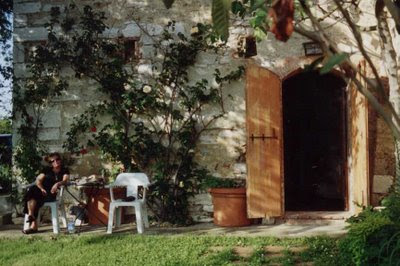
Asciano is a small town in the heart of the Tuscan region steeped in history dating back to the Etruscans. When we finally arrive there, having driven from Rome, one of the first things we spy is a ATM secreted in a medieval wall. What a contrast.

We spend the next hour trying to find our accommodation. We do laps of the narrow streets and only arouse stares from bemused locals. We seek direction from a young man at the Carabinieri station. We struggle to communicate so I show him the address and he immediately gives me the directions in Italian. We smile at each other and part. I feel as useless as a fur lined teapot. We drive roughly in the direction he gestured and wind up driving back through the same streets as before. This time things are different though. We are now behind a funeral procession, which naturally has right of way. We don’t wish to offend the recently departed on our first day in town. A supervising Caribinieri officer takes pity on us and we again seek directions. After giving us directions in Italian he steps back and waits for a response. He then gestures to us to follow. He figures it’s simpler to lead us to the spot in his car –and he does just that! We offer our most humble ‘grazie’ and he leaves us to negotiate the steep, narrow track that is ‘Il Falconcello’ As we ascend this above average goat track Carlo’s house appears above us. It is a restored farmhouse with a rambling garden and lots of instant appeal. Our home for the next two weeks is perfect. Terracotta, white walls and dark wood set in a rustic garden where iris and rosemary predominate. The irises are so profuse they remind one of agapanthus at home. The view across the valley and above the town is breathtakingly beautiful. So Tuscan, so historically coloured, so peaceful. It is a pop up book backdrop beyond belief.

Saturday, September 20, 2008

How Does Your Classroom Environment Support Learning?

Every environment implies a set of values or beliefs about the people who design and use the space. For example tables arranged in rows rather than clustered in groups suggests the teacher believes children learn best in isolation from one another, and values individual work over group activities.

Thoughtfully designed environments influence the inhabitants in subtle ways. An environment may bore, may over stimulate, calm or agitate those in it. Spending large amounts of time in an environment deemed unpleasant will eventually exact a toll.


Classroom environments reflect the values and beliefs about children, families, the social construction of knowledge held by teachers.The layout of the physical space of the classroom needs to be welcoming, to foster encounters, communication, and relationships. The arrangement of furniture storage should encourage choices, problem solving, and discoveries in the process of learning.

Creating Connections and a Sense of Belonging
Children spend the majority of their waking hours away from their homes and families. They strive to establish relationships, to belong to groups. If we can make our classrooms welcoming, homelike, we build the connection between home and school as they develop new friendship and relationships in the wider community.

Consider:
Are there spaces in your classroom for people to gather, to get to know each other, to connect?
Does every person have a place /places to store their belongings and materials so they are accessible and organized?

Making The Most of Classroom Space
A good way to begin thinking about your classroom is to consider what you value about the spaces you have. Stand in the room by yourself and consider how the various spaces make you feel and the effect they have on your behaviour and thinking. Arrangements of spaces should encourage children to pursue their interests and questions, represent what is on their minds, build strong relationships and a love of learning.

Consider:
Are the spaces in your classroom flexible?
Can things be arranged and rearranged for specific purposes?
Are there spaces for different purposes – whole group, small groups, and individual work?
Is the space in your classroom arranged to allow children to move within the room, safely and smoothly? Can children access resources efficiently and quickly, avoiding ’traffic jams?’

Bringing the Outside In
Children use their senses to investigate the world and to learn. Whilst we include things like manipulatives, music, play-dough for our youngest students, we often forget to include the natural world in our rooms. There are many ways to incorporate natural light, fresh air, plants, water into your room, to bring the outside in, to stimulate the senses.

Consider:
Have you made the most of the natural light in your classroom?
Do/can you open the windows?
Is there evidence of the natural world in your classroom?
Are manipulatives arranged attractively? E.g. in clear plastic containers to emphasize shape, color, and allow easy access

Working spaces that fit the individual
Furniture should be selected that is the right size for the age group of children. It should have flexibly of function. Too often children find themselves working with the wrong size furniture. Adjustable tables are very good, so long as the chairs at your disposal also allow for students of varying sizes.

Each piece of furniture should have a clear purpose and be used regularly, otherwise it should be shipped out. Each child should have enough room to work so that their arms do not bang into one another. In the case of left-handers they should sit at the left hand corner of the table with their left arm having room to move. Left-handers may also need to sit at a different angle to their work and they need space to do this. I share this piece of advice as a life long ‘lefty.’ We need to be guided by the Goldilocks principle and make things “just right.”

Children with attention difficulties need extra consideration. A separate work place with minimal distraction visually and socially for specific tasks may be necessary. This should be seen as a requirement rather than a punishment and a variety of children may choose to work in this way at different times. Setting up such an area, provides flexibility when setting work tasks. Children should be encouraged to think about how they work best at different tasks and be praised for this reflection.

Consider:
Is there any unused or under used furniture in my classroom?
Are there spaces for quiet individual work?
Are there spaces for group work?
Is there a space for a whole class meeting area?
Leaving “traces” of Learning
Displaying documentation of learning pathways one of the ways we can scaffold the learning of our students.

Displays that document understandings with which students are currently grappling, remind the student of important teaching points. Positioning of such learning “tracks” is crucial to their use by students. Ideally they should be placed at eye level, like charts clustered easily referred to by students and teacher.

Student work displayed is best annotated explaining the process of the learning or understandings gained. In this way we can display a selection of student work to celebrate learning and to remind learners of new understandings gained.Displays are dynamic, changing to reflect the current learning focus of different curriculum areas.

When anyone walks into your classroom it should be immediately apparent what the learning focus is at that time. Still highlighting Easter displays in August adds new meaning to the term “static display!


Consider:
Are my displays current?
Are displays well presented?
Are the displays in our room utilized by learners and teachers?
Do displays scaffold learning?
Teaching organisational skills

As children develop, you should expect a greater degree of independence. This can be supported by the layout of the room and storage so that pupils can access learning resources independently. Resources such as manipulatives, a variety of writing papers and implements, materials for construction need to be accessible to students. Dictionaries and thesauruses should be readily accessible. A classroom library should display books in such a way that invites the children to easily make a selection.

These are such important life/organisational skills and are particularly pertinent for children with Special Needs. Having equipment accessible is important.
Easily accessible materials and supplies can eliminate delays, disruptions, and confusion as students prepare for activities. It also allows students to use their initiative. In poorly arranged classrooms, students spend a lot of time waiting — waiting in line, waiting for assistance and direction, waiting to begin. To eliminate most of this unproductive waiting, store frequently used items in a highly visible area.

Consider:
Are like resources housed together?
Are resources labelled so children know where to find them and where to return them?

In Conclusion …….
There is ample evidence that many classrooms are unhealthy places to be, especially in the winter. Ventilation is vital for all classrooms.
An uncluttered space, well placed furniture, organised materials, simple and clear displays, and carefully considered seating arrangements will all assist in keeping the environment clean and healthy. And most importantly they will enhance the teaching and learning of all those working within.

It’s no secret that a safe, clean, comfortable and attractive classroom can stimulate learning and help build a classroom community. But setting up the physical environment of your classrooms can be quite daunting, when faced with older buildings, large classes and insufficient storage space. You can make the most of your classroom environment by carefully considering your needs and the needs of your students.

Reggio Emilia educators stress the need for a classroom environment that informs and engages the child. They consider the physical environment to be ‘another teacher.’ in the sense that it can provoke curiosity in children, support learning, provide spaces for different types of work, reflects the learners within the room, includes something of nature and is aesthetically pleasing.It is said that in the most predictable environments, the most unpredictable things often occur.

We are advocating for all those young learners out there.
We urge you to consider the potential your classroom holds for making an even better contribution to the learning that takes place within the classroom walls.

Take another long look around your classroom…

* A special thank you to Vicki for working with me on this special posting. Her insights contributed greatly to what you have just read.

Alan Wright and Vicki Froomes
Education Consultants
ALVIC Educational Consultancy

Thursday, September 18, 2008

Persuasion and the Writer's Notebook

This week I was planning with teachers as they made preparation for the next term’s work. Their major writing focus will be persuasive texts and the question arose as to how to make a strong connection with the writer’s notebook and the persuasive texts. This set me to thinking.

I have harboured a concern that many teachers are not sure how to use the writer’s notebook across the genres. It seems okay when the focus is narratives or poetry, but they appear uncertain as to how to best use the notebook as a resource for developing ideas. It is important to see the notebook as launching pad for writing. So, how do we make the notebook our starting point?

I started to think about the ways I could support the teachers with whom I was planning. What could I be doing as a writer to model for them and their students?

It was then that an idea came calling! For the next three weeks I intend to link my reading of local, national and global issues such as global warming, drought, poverty, education, climate change etc to my notebook writing. As I notice articles in newspapers, on the internet, in magazines, -or as I watch a television report on a topical issue I will write about that issue from a personal perspective. I will document my various opinions in the hope of finding my voice on these issues.

At this point in time my aim is not to write a persuasive essay. It is purely to develop a stance and see where it takes me as a writer. At the same time, I will talk about these issues, with friends, family and anyone else who comes by. A glass of shiraz, and a stimulating discussion sound quite appealing. In this way these pre writing conversations will assist me to refine my view. I am aware that my writer’s notebook is a place to collect ideas and experiment, so that’s exactly what I intend to do.

When the new term begins, I will have a collection of writing to share with the teachers and students with whom I work. I will be able to share my discoveries and I can invite them to take a similar journey.

I see this notebook writing as a foundation for developing a persuasive essay. When I reach this point, I can look more closely at the text features and structure of persuasive texts. My initial writing will help me find my argument and the structure will assist me to construct it effectively. It is at this point that I lift my notebook ideas out into the light. I will develop them further. My notebook will have served me well as an incubator for my ideas, my thinking, my voice.

Often when teachers ask students to respond to newspaper articles and the like, they dish up a précis, or recount of the documented issue. We don’t want the 5W’s of the journalistic world at this point. We want a response that clearly shows what the writer thinks, where they stand, what they wonder about, and what questions remain. To avoid this time honoured rehashing of events we need to get them to talk to other students regarding their response. This must take place before they contemplate picking up a pen or pencil. To facilitate this, small group discussion, partner sharing or random sampling could be utilised. We must not forget what the aim is here - to get them thinking and talking to their peers. This pre writing conversation allows students to articulate their ideas prior to writing. Their writing intentions and their point of view have a chance to form, and develop. Then it’s off to the notebook to pour out and capture their thoughts.

I look forward to next term, but first I look forward to my personal writing challenge and what I discover along the way…

I'll keep you posted.

A Slice of Life Story


True Dinks- this really happened...New York 2003

Bizarro World Visitor

At the risk of sounding like I am beginning to lose my tenuous hold on reality, the longer I live in New York, the more I believe in the existence of conspiracy theories. I am increasingly of the opinion that some perverse being from a parallel wacky world keeps sending individuals through a time portal to manifest themselves in my everyday life. These individuals, whilst generally harmless have a definite leaning towards the fruitcake category. These half -baked fruitcakes crop up regularly in the course of my travels around this place. I am yet to work out why.

Before you dismiss me, I invite you to recall Jerry Seinfeld’s ‘Bizarro world’ where everything was the opposite of what you knew. –And where was that centered? – New York of course!

To support my theory I cite W.E. #327 (That’s Wacky Experience number 327) I had on the No 38 bus whilst traveling down DeKalb Avenue in Brooklyn’s Fort Greene area one workday afternoon.

I climbed on board and nonchalantly sat down. When I looked up, there directly opposite me sat a small, elderly man. The first thing I noticed was his seemingly well-tended grey beard. He was seated right next to the front exit. He was almost gnome like in stature, but this was not what boggled my eyes. It was his traveling outfit. He wore a turquoise tracksuit of dazzling intensity. Over this he wore a pair of loose fitting lime green shorts. The legs of his tracksuit were tucked neatly into a pair of matching lime green socks pulled up to calf height. He wore a lime green woolen cap with a small, red flashing light in the center of it. He also wore a bright yellow mask that was pulled up onto his forehead. It reminded of the type of mask one associates with masquerade balls. On his knees he wore large, black kneepads, not unlike the kind worn by a small minority of skateboarders, or old floor tilers with arthritic knees. Around his shins he wore two larger flashing red lights. They were the kind one more frequently sees on the back of a bicycle. His feet were resplendent in neat black slippers with silver zippers. As he sat there flashing on and off, his little eyes darted left, then right. I began to speculate on what he may be contemplating. My first thought was that he might well have been an ultra safety conscious cyclist in search of a conveyance. But, …why the yellow mask?

A young woman securely wrapped in a winter coat and hat boarded the bus and squeezed into the last available seat on the bus. Ironically it happened to be right next to my little flashing man. Her immediate response was to stare straight ahead of her. She wore a hat that almost covered her eyes and as she reached up to push it further back on her head she began to grow increasingly aware of the little man beside her. She snuck a furtive look at his flashing shins and then discretely moved her eyes towards his flashing cap. She then turned her face away like a naughty child. The look on her bemused face said it all.

When the bus stopped outside Fort Greene Park, the focus of our attention was quite literally gone in a flash.-Down the steps and on his way. We who remained on board were left to wonder about the strangely attired visitor seemingly from another time and place.
Later that week I was talking to my friend Michael Collins about my latest sighting. I told him of the strange little man adorned in gaudy colors and flashing lights.
Michael immediately replied, “I know the guy you’re talking about! When we lived in St.Felix Street, he used to do laps of our block”
“On a bike?” I enquired, keen to confirm my theory
“No, he just used to walk or dance his way along the street.”
Then Michael described in perfect detail the outfit I had seen the man wearing on the bus.
Hmm, A visitor from Wacko World I thought to myself?
I wonder who will visit me next?

Half baked cookies on the sidewalk
Half baked people on my the bus
There’s a little bit of fruitcake
Left in every one of us.

Jimmy Buffett ‘Fruitcakes’

Wednesday, September 17, 2008

Take Home Writing Kits!

Another Way To Improve Writing In Your Classroom –Mission Possible!


The idea of developing a “Take Home Writing Kit” is a chance to enhance the home school connection, AND at the same time assist your students in their development as writers. As teachers we place tremendous emphasis on children reading at home to encourage their literacy development.Unfortunately, we have not been as passionate in our efforts to develop the home- school writing connection. Writing is frequently viewed as an individual activity where the parent plays the role of supervisor, rather than a support person.

Through the idea of the “Take Home Writing Kit, we can assist students to develop a positive self image about themselves as writers as well as providing extra opportunities to practice the skills and strategies necessary to improve their writing. In this way we promote writing as an essential partner to reading in the home.

To set up your writer’s kit you will need to acquire a small carry case, or back pack and then decorate and label it so that it becomes a stand out resource. Following this, you need to fill it with an assortment of materials that will delight the hearts of your young writers. E.g. markers, pencils, pens, assorted papers, card, envelopes, stickers, stencils, glue sticks, scissors, etc
Once you have set up your kit, it should be presented to your students along with an explanation of how you want it to be used to further support them in becoming effective writers.

You will need to set up a borrowing system to monitor the use of the kits and you will also require a method for allowing your students to share, display and publish the writing they bring form home to the classroom.

The writing that is generated could be stored in a ‘special volume’ that is made available to all members of the class to read. You might also consider sending this collection of writing home with students as well.

Sara Coeyman, a young teacher from Brooklyn,NY took up the challenge of implementing these kits with her kindergarten class. Sara was astounded how much writing this simple project generated among her eager young writers. She set up a display area for their writing, but this quickly filled, so she organised special books to store all the writing, drawings, maps that the children created. the children rarelt forgot to return the kit and parents added new resources which thrilled the students and their teacher. By the end of their first school year, Sara had a class of confident self directed readers -and writers.


How To Introduce The Writer’s Kit

Dear Parents,

It is with great pleasure that I announce that your child has use of the Take Home Writer’s Kit tonight. You can help your child experience the pleasure of being a successful writer. Below are some tips on how you can support your child to become a more confident writer.

Talk to your child about the writing that he or she is doing at school. You now have the opportunity to work together to further the development of their writing.

Discuss and write about things together that interest you. Think about the funny things that have happened to you, your favorite animal, a favorite book, a recipe, a list, a family story, a short biography, a strong memory, a child hood experience. All these things can provide a writing model for your child to follow. It is wonderful for your child to see you writing as well. You don’t need to write a lot, but at least let them see you writing.

Your child may be taking home this writing kit to finish publishing a piece of writing that they have been doing in class. If this is the case, encourage and assist your child. We want our children to do their very best and be proud of what they do.

Their writing may consist of many things – a letter to a friend or relative, a poem, a drawing, a map, a report, a memoir, a recount of an experience, a song, a play etc.

Above all enjoy this special writing opportunity for your child and yourself. Remember, that your child should be encouraged to take responsibility for the writing. Resist the temptation to take over.


Ways To Care For The Writer’s Kit

• Please make sure that everything is put back where it belongs before it is returned to school.

• If anything breaks, or runs out please try to replace it or put something new in the kit as a replacement.

• Make certain the kit comes back with your child tomorrow. We have many keen young writers in our class who are all very eager to to take home this special kit.

• If you would like to donate materials to the Writer’s kit, please feel free to do so. We greatly appreciate anything you have to spare such as extra markers, pencils, pens, paper, glue sticks, stickers, stencils, lettering guides and the like.

Happy Times Writing!

Monday, September 15, 2008

Rereading For Ideas


I know from experience that I am forever rereading writing pieces from my notebooks. It is amazing how often such rereading assists me to dig up a new idea to feed my writing addiction. Virginia Woolf defines rereading as a chance to find diamonds in the dust-heap. I am definitely covered in dust and constantly looking for precious gems.

I am acutely aware that rereading is vitally important to me as a writer. Apart from the possibility of finding a new writing thread, I am also reliving the moment in time when I first captured a particular entry. On some occasions rereading connects me with previously over looked memories or ideas. So apart from reading to revise or proofread, I would also add rereading for the express purpose of excavating ideas. This rereading is akin to rummaging through a toy box as a child and discovering a lost treasure

Ralph Fletcher in his great little book, ‘Breathing in Breathing Out’ talks about this very act of rereading:

“Some writers claim they never revisit their notebooks. But most of us go back incessantly, rummaging, rereading, looking for- what? For me, I don’t usually know what I’m looking for until I find it. And then: Aha!”


Like Ralph, I don’t always know what I am specifically looking for as I reread, but I am generally confident that I will find something useful to me as a writer.

One of the many things that need to be modelled for young writers is the way other writers excavate ideas. When students lament that they have no idea what to write about, you are doing them a huge favour by suggesting that they go back to their previous writing

You could encourage your students to reread for a number of purposes

• Reread consciously looking for something to write about, or something to rewrite

• Reread randomly hoping to land on a line or image that inspires you to write. This rereading is skimming in search of a chance landing.

• Reread to find your voice. Rereading notebook entries written in different voices can assist the writer to find the voice, the tone appropriate for a new writing piece.

• Reread to find material related to a particular theme or idea.

The writer’s notebook is not the place where you bring your unpolished gem of an idea to polished completion, but it definitely provides a place to begin shaping and reshaping selected pieces and rereading supports this process.

What does this mean for you and your students? Well, for a start they will need plenty of notebook entries. There's a message here!

By this time of the year their notebooks should be brimming with writing seeds, experimental pieces and writing ideas. If their notebooks have been sparsely used, and intermittently visited, then rereading for new ideas isn't going to be all that fruitful I'm afraid. In these situations, neither the teacher, and as a natural consequence the students, have developed a perception of the notebook as a gathering point for writing.

The notion of rereading for ideas relies on the writer being able to choose from a veritable feast of ideas and thoughts previously recorded -and this rests on a foundation of regular writing opportunities. It's hard to make discoveries when the toybox is practically empty...

Monday, September 1, 2008

Celebrating 26 Letters


It is National Literacy Week in Australia (September 1-7) –A time to celebrate all things literate! I'm going to start at the very beginning with my celebrations. I want to celebrate the basic building blocks of our literate society –the alphabet!

In my reading about writing I often come across passages that make me sit up and really take notice. The writing of Carl Leggo had me reacting thus. Carl Leggo, is a poet and associate professor at the University of British Columbia in Vancouver where he has been teaching, reading, researching and writing for more than a decade. The following brief writing exercise that Carl devised for his students provided renewed awareness of the immense power contained within the alphabet.

Invite your students to write down the 26 letters of the alphabet. Then ask them to circle their five favourite letters. Following this ask them to write five words that begin with each of the five favourite letters. Some students will gasp with horror because they have ‘X’

Next ask them to look through their 25 words for poems. Many will be delighted with the music of alliteration that begins to sing in their head. They will delight in the zany connections they discover among seemingly disparate words. Celebrate these discoveries!

In this brief writing exercise students begin to look at the alphabet with a sense of heightened awareness. They catch glimpses of untamed energy that pulses through the experience of word making.

When we write we work and play with the alphabet up close and personal. All too often we take the alphabet for granted. And yet writers create their worlds in words that grow from these magical letters. The alphabet provides the building blocks for constructing knowledge. It is used to reveal identities and relationships. It is a powerful resource that has infinite potential for readers and writers as we grapple with our communication challenges.

So this week as you celebrate literacy as a window to many worlds, don’t overlook the humble alphabet -the foundation for all the reading and writing we enjoy. I am grateful to Carl Leggo for reminding about incredible contribution made by 26 little shapes. It might be time to make alphabet soup!